 Taiwan opened a 15-megawatt data center in Tainan with 1,760 Nvidia H200 chips and 144 Blackwell units. This isn’t about compute capacity. Taiwan is converting its semiconductor manufacturing dominance into AI deployment advantage by controlling three critical variables: chip production, energy infrastructure, and allocation priority.
Taiwan manufactures 90% of the world’s advanced semiconductors. The country now transforms that manufacturing advantage into deployed AI infrastructure while others wait in queue. Here’s why this matters for your strategic positioning:
- Taiwan secured 1,760 H200 chips when Nvidia deprioritized H200 production for most buyers
- The facility includes 15 megawatts of pre-positioned energy capacity, solving the power constraint that blocks AI deployment elsewhere
- Taiwan added 144 Blackwell chips (GB200 NVL72), giving bleeding-edge inference capability while most markets wait for H200 access
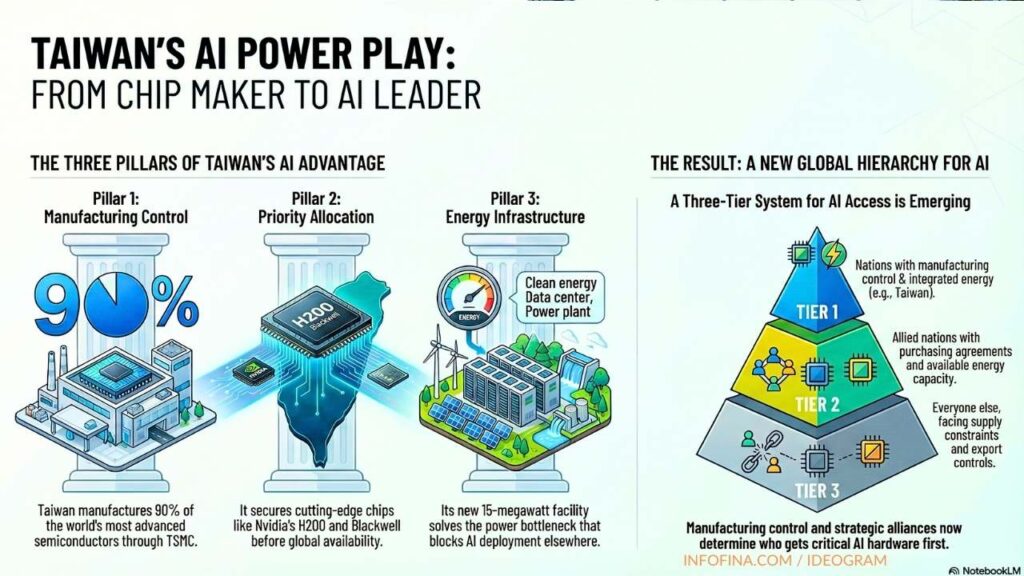
- This creates a three-tier compute allocation hierarchy: manufacturing control holders, allied nations with agreements, and everyone else
What Is Taiwan’s AI Infrastructure Strategy?
Taiwan’s “Ten Major AI Infrastructure Projects” target over $510 billion in economic value by 2040. President Lai Ching-te frames this as transforming Taiwan from hardware powerhouse to “AI island.”
The strategy converts production control into infrastructure control. Taiwan makes the chips through TSMC. Taiwan gets priority allocation. Taiwan builds vertical integration from chip production to deployed compute to AI services.
This differs from Japan and South Korea. Those nations pursue digital autonomy through policy and partnerships. Taiwan owns the industrial capital: TSMC, MediaTek, and the manufacturing ecosystem.
Strategic Reality: Taiwan’s manufacturing control creates allocation priority that translates directly into deployed AI advantage.
How Does H200 Allocation Work?
Nvidia deprioritized H200 manufacturing months ago. The company shifted focus to Blackwell and the upcoming Rubin architecture.
H200 production now serves a specific purpose: fulfilling commitments to hyperscalers and sovereign AI programs in allied nations.
Taiwan secured 1,760 H200 chips when most of the world waits in queue. This isn’t about specs. This is about allocation position.
China’s clients face supply constraints despite robust demand. The H200 delivers nearly six times the performance of the H20, the most advanced chip legally exportable to China. Chinese cloud providers and enterprises place aggressive orders and lobby for relaxed restrictions. They’re not getting priority access.
Taiwan manufactures 90% of the world’s most advanced semiconductors through TSMC. The country now converts that manufacturing advantage into deployed compute advantage. You make the chips. You get the chips.
Allocation Reality: Manufacturing control determines who gets access to leading-edge AI hardware before market availability.
Why Energy Infrastructure Matters for AI Deployment
Traditional data centers operate at 5 to 10 kilowatts per rack. AI-optimized facilities now require 60+ kilowatts per rack in the same physical footprint.
Wholesale electricity costs jumped 267% in areas near data centers over five years. Customers absorb these increases.
Taiwan’s 15-megawatt facility isn’t about compute alone. It’s pre-positioned energy capacity. You need to solve the power equation first to deploy AI at scale. Most regions haven’t solved this yet.
The Tainan center includes 144 Blackwell chips in GB200 NVL72 configuration. Blackwell runs 1.5 times faster than H200 for training. Blackwell runs five times faster for inference.
Having 144 Blackwell units positions Taiwan with bleeding-edge inference capability while most markets wait for H200 access.
Infrastructure Constraint: Energy capacity, not chip availability, becomes the limiting factor for AI deployment at scale.
How Taiwan Differs from Other Nations’ AI Strategies
Taiwan exports the components of digital sovereignty. Other nations buy TSMC chips to build their AI capabilities. Taiwan now builds vertical integration from chip production to deployed compute to AI services.
Japan and South Korea pursue digital autonomy through policy and partnerships. Taiwan possesses the industrial capital directly: TSMC, MediaTek, and the manufacturing ecosystem. The country converts production control into infrastructure control.
China’s share in global mature-node chip production rises to 47% by 2027. Taiwan’s share in the same category declines to 36%. Taiwan maintains 90% dominance in advanced nodes.
The Tainan facility demonstrates how to convert advanced manufacturing into deployed AI advantage before market dynamics shift.
Competitive Positioning: Taiwan stacks manufacturing control, energy infrastructure, and allocation priority while other nations optimize for single variables.
What the Compute Allocation Tiers Mean for 2027
The U.S.-China chip diplomacy reveals strategic positioning in real time. The H200 delivers nearly six times the performance of chips China legally imports. Chinese accelerators lag 2 to 3 generations behind in compute performance.
Taiwan sits between these dynamics. The country manufactures what both sides need while building its own sovereign compute.
You’re watching the formation of compute allocation tiers:
Tier One: Entities with manufacturing control, energy infrastructure, and early access to next-generation architectures.
Tier Two: Allied nations with purchasing agreements and energy capacity.
Tier Three: Everyone else waiting for export approval and dealing with constrained supply.
Taiwan’s positioning in tier one isn’t about innovation velocity. It’s about controlling three variables simultaneously: chip production, energy infrastructure, and allocation priority.
Most nations optimize for one variable. Taiwan stacked all three.
Market Structure: Manufacturing control creates durable advantage in AI infrastructure allocation, not temporary positioning.
What Variables Determine Taiwan’s AI Advantage Through 2040
The $510 billion economic value projection through 2040 assumes Taiwan maintains this positioning.
That assumption depends on three factors:
- Whether TSMC’s manufacturing advantage persists
- Whether Taiwan’s energy infrastructure scales faster than competitors
- Whether allocation priority remains tied to manufacturing control
Those are the variables worth tracking. The Tainan facility is the first visible output of this strategy.
The next twelve months reveal whether other nations replicate the model. The alternative: manufacturing control creates a durable moat in the AI infrastructure layer.
Strategic Dependency: Taiwan’s AI advantage holds only if manufacturing dominance, energy scaling, and allocation priority remain coupled through 2040.
Frequently Asked Questions
What makes Taiwan’s AI data center different from other facilities?
Taiwan’s Tainan facility combines 1,760 H200 chips and 144 Blackwell units with 15 megawatts of pre-positioned energy capacity.
This solves both the hardware allocation problem and the power constraint that blocks AI deployment elsewhere. Most facilities address only compute capacity.
Why does Taiwan get priority access to Nvidia chips?
Taiwan manufactures 90% of the world’s advanced semiconductors through TSMC. This manufacturing control translates into allocation priority.
Nvidia deprioritized H200 production for most buyers, therefore Nvidia fulfills commitments to entities with strategic manufacturing relationships first.
How does energy infrastructure limit AI deployment?
AI-optimized facilities require 60+ kilowatts per rack, compared to 5 to 10 kilowatts for traditional data centers.
Wholesale electricity costs jumped 267% in areas near data centers over five years. Without pre-positioned energy capacity, you cannot deploy AI at scale regardless of chip availability.
What are the three tiers of compute allocation?
Tier one includes entities with manufacturing control, energy infrastructure, and early access to next-generation architectures.
Tier two includes allied nations with purchasing agreements and energy capacity. Tier three includes everyone else waiting for export approval and dealing with constrained supply.
How does Taiwan’s strategy differ from Japan and South Korea?
Japan and South Korea pursue digital autonomy through policy and partnerships. Taiwan owns the industrial capital directly: TSMC, MediaTek, and the manufacturing ecosystem.
Taiwan converts production control into infrastructure control, building vertical integration from chip production to deployed AI services.
What is Blackwell’s performance advantage over H200?
Blackwell runs 1.5 times faster than H200 for training. Blackwell runs five times faster for inference.
Taiwan’s 144 Blackwell units provide bleeding-edge inference capability while most markets wait for H200 access.
Will China catch up to Taiwan in AI infrastructure?
China’s share in global mature-node chip production rises to 47% by 2027. Taiwan’s share in the same category declines to 36%.
However, Taiwan maintains 90% dominance in advanced nodes. Chinese accelerators lag 2 to 3 generations behind in compute performance because of export restrictions.
What determines if Taiwan’s AI advantage lasts through 2040?
Taiwan’s position depends on whether TSMC’s manufacturing advantage persists, whether Taiwan’s energy infrastructure scales faster than competitors.
And whether allocation priority remains tied to manufacturing control. If any variable breaks, the $510 billion economic value projection becomes unreliable.
Key Takeaways
- Taiwan converts semiconductor manufacturing dominance into AI deployment advantage by controlling chip production, energy infrastructure, and allocation priority simultaneously.
- Manufacturing control determines access to leading-edge AI hardware before market availability, creating a three-tier allocation hierarchy.
- Energy capacity, not chip availability, is the limiting factor for AI deployment at scale. Taiwan’s 15-megawatt facility solves this constraint.
- Taiwan’s 1,760 H200 chips and 144 Blackwell units provide infrastructure advantage while most markets wait in queue for older hardware.
- The $510 billion economic value projection through 2040 holds only if TSMC’s manufacturing edge, Taiwan’s energy scaling, and allocation priority remain coupled.
- The next twelve months reveal whether manufacturing control creates a durable moat in AI infrastructure or if other nations replicate Taiwan’s model.