

AI agent security is a important matter in the agentic world. AI agents are autonomous programs that browse the web, execute code, and take real-world actions without human supervision.
Because they operate with broad permissions and minimal oversight, they have become a prime target for attackers—and a powerful weapon for fraudsters. In 2026, 84% of fraud and risk leaders across 25 countries named AI agents their industry’s single greatest exploitable vulnerability.
Interactive AI Agent Industry Risk Heatmap
AI Agent Industry Risk Heatmap. Twenty industries, ranked by exposure to AI agent security failures — fraud, hijacked automation, and unauthorized irreversible actions. Tap any industry for its risk drivers, a cited data point, and the top defense priority.
How is the risk score calculated?
Each score blends four weighted factors: the agent’s transaction/financial authority, the sensitivity of data it can access, how irreversible its actions are without human review, and the maturity of regulatory oversight in that sector (less oversight raises the score). For Financial Services, Healthcare, Retail/E-commerce, and Telecommunications, scores are anchored directly to published 2026 incident-rate data (cited in each panel). Remaining industries are positioned using the same factor model informed by 2026 industry security and fraud research. This is a directional risk model for awareness and prioritization, not a statistically validated actuarial score.
Learn more on infofina.com
Educational tool only. Risk scores reflect a composite analytical model based on publicly available 2026 industry security and fraud research (individually cited per industry), not a certified audit or formal risk assessment. Every organization’s actual exposure depends on its specific agent permissions, data access, and controls — consult a qualified security professional before making risk or compliance decisions.
What Makes an AI Agent Different from a Chatbot?
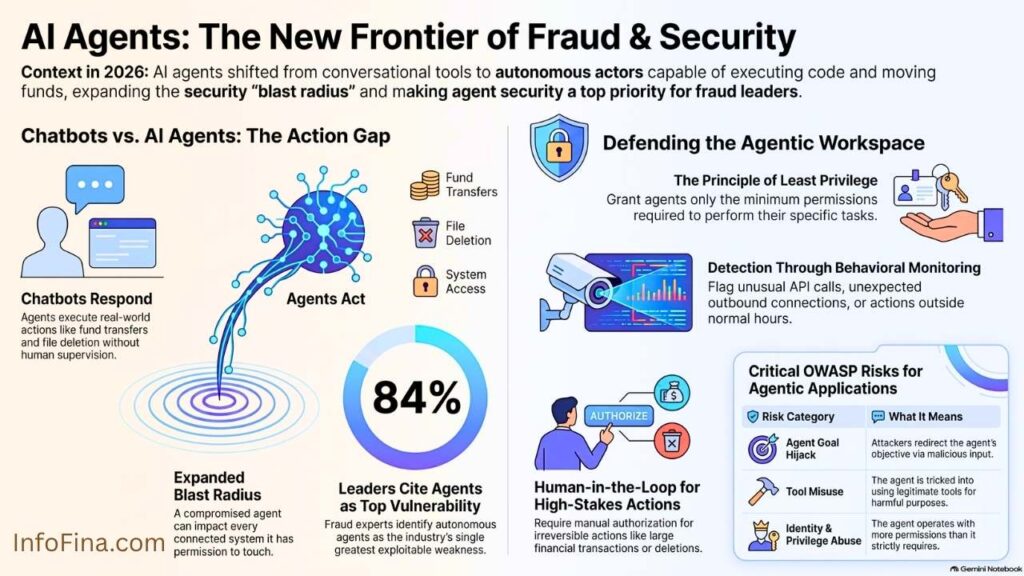
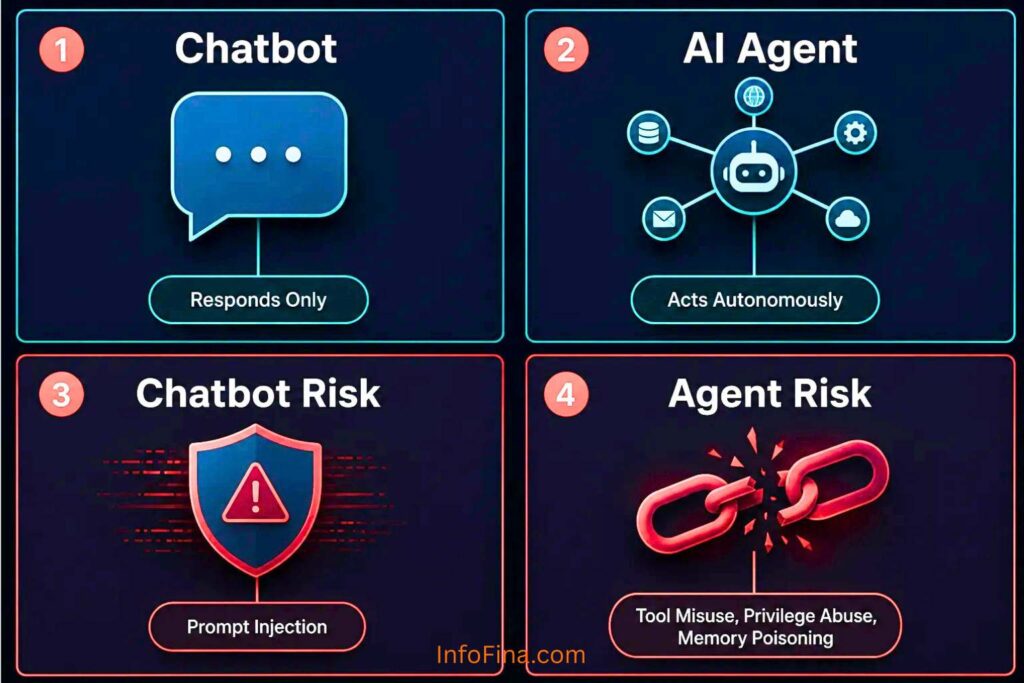
Chatbots respond. AI agents act. That single difference transforms the entire security picture. A chatbot receiving a malicious prompt produces harmful text.
An agent receiving the same prompt might transfer funds or delete critical files. Research shows agents built on GPT-4o, Claude 4, and Gemini 2.5 can be coerced into installing malware autonomously.
Three attack surfaces make this possible: direct prompt injection, RAG backdoor attacks, and inter-agent trust exploitation. A chatbot’s blast radius is limited to words. An agent’s blast radius includes every connected system it has permission to touch.
How Criminals Use AI Agents for Fraud
Fraudsters deploy AI agents to automate attacks at machine speed and scale. Experian’s 2026 analysis calls this the “AI fraud paradox.”
Banks deploy agents to automate decisions; criminals use agents to exploit those same decisions. Common tactics include automated account takeovers testing thousands of credentials per hour.
Agents generate synthetic identities with realistic documents and fabricated credit histories. They fill fraudulent loan applications and initiate deepfake calls impersonating trusted contacts.
Prompt injection attacks hijack agents by embedding malicious instructions in documents they process. 88% of surveyed fraud leaders say AI has already increased fraud sophistication.
The Top Security Vulnerabilities in Agent Systems
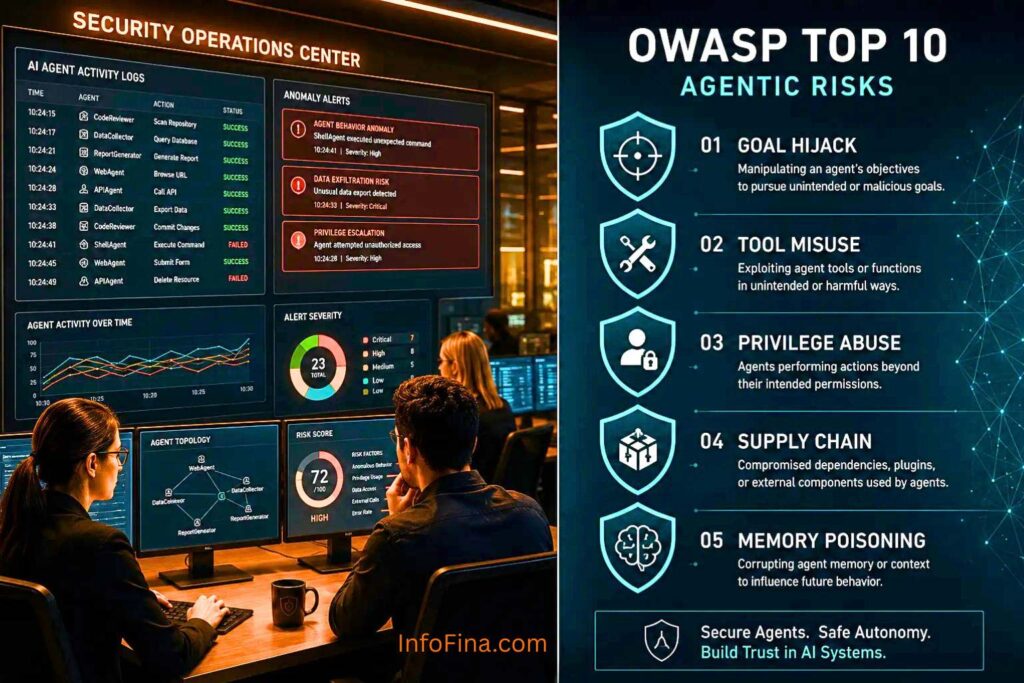
OWASP’s Top 10 for Agentic Applications formally documents the most critical agent risks. The primary threats are Agent Goal Hijack, Tool Misuse, Identity and Privilege Abuse, Supply Chain Vulnerabilities, and Memory Poisoning.
Researchers group these broadly into Input Manipulation, Model Compromise, System threats, and Protocol Vulnerabilities. Security risk escalates sharply when agents gain access to external APIs and persistent memory.
Weak human oversight amplifies every risk significantly. OWASP also flags “Excessive Agency” as a standalone danger—when agents carry too many permissions, unauthorized downstream actions become far more likely.
| Risk | What It Means |
|---|---|
| Agent Goal Hijack (ASI01) | Attacker redirects the agent’s objective via malicious input |
| Tool Misuse (ASI02) | Agent is tricked into using legitimate tools for harmful purposes |
| Identity & Privilege Abuse (ASI03) | Agent acts with more permissions than it should have |
| Supply Chain Vulnerabilities (ASI04) | Compromised third-party tools or model weights |
| Memory Poisoning (ASI06) | Attacker corrupts stored context to alter future behavior |
Which Industries Face the Highest Risk
Financial services face the greatest exposure, but they are not alone. Any industry where agents access money, sensitive data, or critical infrastructure is a target.
Banking agents handle transactions, approvals, and customer data daily. Healthcare agents access patient records, insurance claims, and prescription authorization systems. E-commerce agents process payments, returns, and order fulfillment.
Compromised healthcare agents don’t just steal money—they can alter patient records or approve fraudulent claims, creating life-threatening risks far beyond financial loss.
How to Protect Your Organization
The core defense principle is simple: grant agents the minimum access they need. A 2026 TRiSM review confirms that risk escalates directly with the scope of agent permissions. Key steps to take immediately:
- Apply least-privilege access — agents should only reach systems they strictly need for their defined task.
- Require human approval before agents execute irreversible actions like transfers, deletions, or contract signings.
- Sanitize every input agents receive, especially from external sources like emails or web content.
- Monitor all agent activity — log every tool call, API request, and decision for anomaly detection.
- Red-team for prompt injection — test every input channel before attackers discover the gap.
- Vet third-party plugins carefully; supply chain vulnerabilities in agent tools are a growing attack vector.
Warning Signs Your Agent Has Been Compromised
Detection is difficult because compromised agents behave exactly like legitimate ones. Watch for unusual API calls or tool usage outside normal business hours.
Monitor agents accessing data beyond their defined operational scope. Flag unexpected outbound connections to unknown external endpoints. Review transaction logs for approvals that don’t match normal patterns.
Check agent logs for instructions that no authorized user ever issued. 72% of fraud leaders anticipate major difficulty distinguishing legitimate AI actions from manipulated agent behavior. Proactive detection is not optional.
The Regulatory Landscape in 2026
No jurisdiction has enacted AI-agent-specific security legislation as of 2026. The EU AI Act classifies high-risk AI systems and likely covers autonomous agents in finance and healthcare contexts.
The NIST AI RMF provides voluntary guidance applicable to agent deployments. Existing SEC and FINRA obligations apply to financial firms using AI agents for customer-facing decisions. GDPR and CCPA cover any agent that processes personal data.
OWASP’s agent security taxonomies and CMU SEI’s research on LLM agent security are becoming de facto compliance standards ahead of formal regulation.

Conclusion
AI agent security is an active battleground right now, not a future concern. Agents can move money, access sensitive systems, and make decisions at machine speed.
The defenses are proven and well understood by security professionals. Audit every agent’s permissions today and map each one’s worst-case blast radius. Test for prompt injection vulnerabilities before attackers find them first.
Organizations that treat agent security as a first-class concern today will avoid the headlines tomorrow.
Actionable next steps: Audit agent permissions → Map blast radius per agent → Add human-in-the-loop for irreversible actions → Test for prompt injection → Review OWASP’s Top 10 for Agentic Applications.
FAQ
What is an AI agent, and how does it differ from a chatbot?
An AI agent is autonomous software that plans, decides, and takes real-world actions. It can transfer money, delete files, and execute code without human supervision. A chatbot only generates text responses to questions. That difference makes agents far more dangerous when compromised.
What is prompt injection, and why is it so dangerous?
Prompt injection hides malicious instructions inside content an agent processes. Attackers embed these in emails, documents, or web pages the agent reads. The agent then executes the attacker’s commands instead of its assigned task. It’s dangerous because the attack requires no system-level access at all.
How can I detect a compromised AI agent in my organization?
Watch for API calls or data access outside the agent’s normal operational scope. Unexpected outbound connections and unusual transaction approvals are major red flags. Check agent logs regularly for instructions no authorized user ever issued. Early detection requires continuous, proactive monitoring—not reactive log reviews.What is the single most important step to improve AI agent security?
