
AI pricing has collapsed roughly 280 times since late 2022. A task that cost $20 per million tokens on GPT-3.5-Turbo now costs as little as $0.07. Better hardware, fierce competition, and software gains drove the drop. More cuts are coming [11].
Podcast
Key Takeaways
- Stanford’s AI Index 2025 confirmed a 280x price drop for GPT-3.5-equivalent quality between November 2022 and October 2024 [11].
- GPT-4-class output fell from about $30 per million tokens in 2023 to under $0.50 by mid-2026 [5].
- Mid-tier models now cost roughly $0.10–$0.15 input and $0.30–$0.60 output per million tokens [8].
- OpenAI cut inference costs in half in June 2026 through software optimization alone [7].
- Analysts expect another 10x decline in inference cost over the next 12–18 months [3].
- Pricing is shifting from flat licenses toward usage-based billing as token costs fall [9].

Why Prices Collapsed
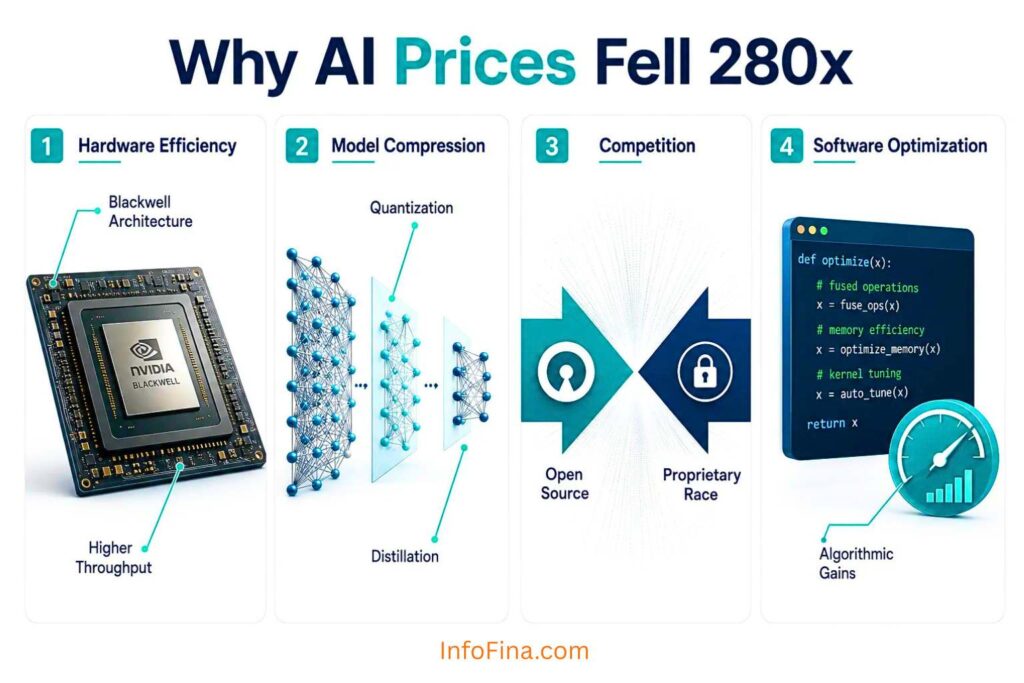
Four forces hit at once, and they reinforced each other. Better chips, smarter model design, open-source rivalry, and clever code all pushed prices down together.
Hardware efficiency set the foundation. Each new GPU generation moves more tokens per dollar. NVIDIA’s Blackwell chips now run open-weight models like Llama 4 at $0.10–$0.30 per million tokens. That same job cost $30 in 2023 [3][5].
Model compression matters too. Quantization and distillation let smaller models match bigger ones. That cuts compute needs without hurting quality much.
Competition remains the biggest accelerant. When DeepSeek released cheap, strong open-source models, every major lab had to respond. Chinese open-source providers pushed enterprise inference to its 2026 low. That happened on August 6–8, averaging $1.16–$1.18 per million tokens [1].
Software optimization is the surprise factor. In June 2026, OpenAI halved running costs for its key models. Engineering changes alone did it, no new chips involved [7].

What AI Actually Costs Today
Pricing splits into three tiers. Matching workload to tier is your biggest cost lever.
Mini models like GPT-4o Mini, Claude Haiku, and Gemini Flash suit high-volume, simple tasks. They run about $0.10–$0.15 input and $0.30–$0.60 output per million tokens [8][11].
Frontier models such as GPT-4o, Claude Sonnet, and Gemini Pro handle nuanced writing. They tackle complex reasoning too. Expect $2–$3 input and $8–$15 output per million tokens, roughly 10–20x pricier than mini tiers [8].
Reasoning models, including o3-class and extended-thinking variants, target deep analysis and coding. They run $10–$15 input and $30–$60 output per million tokens [8].
Most customer service, summarization, and simple Q&A tasks run fine on mini models. That’s a tenth to a hundredth of the cost.
Subscription vs. Pay-As-You-Go: Break-Even Calculator
Subscription vs. Pay-As-You-Go: Break-Even Calculator
AI subscriptions charge a flat fee no matter how much you use. Pay-as-you-go bills per token. Enter your team’s numbers to see which billing model actually wins at your volume — and exactly where the crossover point is.
Pricing based on public rate cards, blended for a representative 1,000-input / 500-output token request.
Monthly cost at your volume
Where you sit vs. the break-even point (requests/user/month)
Learn more on infofina.com
Estimates use representative public rate cards as of August 2026 (blended cost for ~1,000 input + 500 output tokens per request) and are for educational purposes only. Actual pricing varies by provider, plan, region, and workload, and does not constitute financial advice.
Calculating Real Costs
Per-token price is only the starting point. Total cost has layers many teams miss.
Count input and output tokens, then add context-window overhead. Long documents multiply input tokens fast. Prompt caching can cut repeated system-prompt costs by 50–90% [10].
Per-user inference spending dropped sharply. Monthly costs fell from $0.50–$2.00 in Q1 2023 to $0.02–$0.08 by Q2 2026 [3]. Still, GPU rental runs $2–$12.29 per hour, depending on provider [6]. Long-context and reasoning workloads can erase headline savings fast [6][14].
Watch for hidden costs too. Retries, oversized outputs, embedding calls, fine-tuning storage, and observability tools all add up [10].

Will Prices Keep Falling?
Yes. Cheaper accelerators, better compression, and standard prompt caching should keep pushing costs down. Open-weight competition keeps proprietary providers honest [3][12].
Energy constraints and thin margins could slow the pace. Reasoning models, being inherently compute-heavy, may not fall as fast as simpler models.
One forecast expects a major provider to price a mainstream text tier below $0.10 per million input tokens. That could happen by the end of 2026 [2].

Frequently Asked Questions
How much did AI pricing drop between 2022 and 2026? GPT-3.5-equivalent quality fell from $20 to $0.07 per million tokens, a 280x decline. GPT-4-class quality dropped about 95% over roughly three years [5][11].
What’s a token in AI pricing? A token is roughly three to four characters, about 0.75 words in English. Providers quote prices per million tokens since single tokens cost fractions of a cent.
Why do output tokens cost more than input tokens? Generating text needs a full model pass for every token produced. Reading input happens in parallel, so output costs three to four times more.
What’s the biggest mistake companies make with AI costs? Using frontier or reasoning models for tasks mini models handle fine. Defaulting to the priciest model “just in case” can inflate bills tenfold or more.

References
[1] Enterprise AI Costs Hit 2026 Low Driven Price Wars Chinese Open Source Models Research – https://www.scmp.com/tech/tech-trends/article/3363549/enterprise-ai-costs-hit-2026-low-driven-price-wars-chinese-open-source-models-research
[2] AI Inference Cost Trends 2026 – https://sesamedisk.com/ai-inference-cost-trends-2026-5/
[3] LLM Inference Cost Collapse What Changes 2026 – https://futurepicker.com/en/llm-inference-cost-collapse-what-changes-2026-en/
[4] JPMorgan Analysis Token And H100 Prices Drop In Tandem – https://news.futunn.com/en/post/76688806/jpmorgan-analysis-token-and-h100-prices-drop-in-tandem-is
[5] How AI Inference Costs Have Dropped 95% In Two Years And What Happens Next – https://valueaddvc.com/blog/how-ai-inference-costs-have-dropped-95-in-two-years-and-what-happens-next
[6] AI Startup Inference Costs GPU Pricing Break Even Math 2026 – https://vanhubnews.com/article/ai-startup-inference-costs-gpu-pricing-break-even-math-2026
[7] OpenAI Halves Inference Costs Software Alone GPUs Drop Hundreds – https://www.techtimes.com/articles/319638/20260703/openai-halves-inference-costs-software-alone-gpus-drop-hundreds.htm
[8] AI Compute Energy Costs Founders 2026 – https://www.tilakraj.info/blog/ai-compute-energy-costs-founders-2026
[9] AI Inference Costs Reality Check – https://blog.herlein.com/post/ai-inference-costs-reality-check/
[10] AI Inference Cost Optimization 2026 – https://www.tldl.io/blog/ai-inference-cost-optimization-2026