
 Your dashboard says zero visitors from ChatGPT.
You check Google Analytics. Nothing. Search Console. Nothing. Your referral traffic report shows Reddit, Twitter, a few industry blogs. But the AI platforms processing 600 million queries daily? Silent.
Meanwhile, your competitor just published a case study about “dominating AI search.” You are wondering if you are invisible.
You are not invisible. You are measuring the wrong thing entirely.
The Traffic That Never Arrives
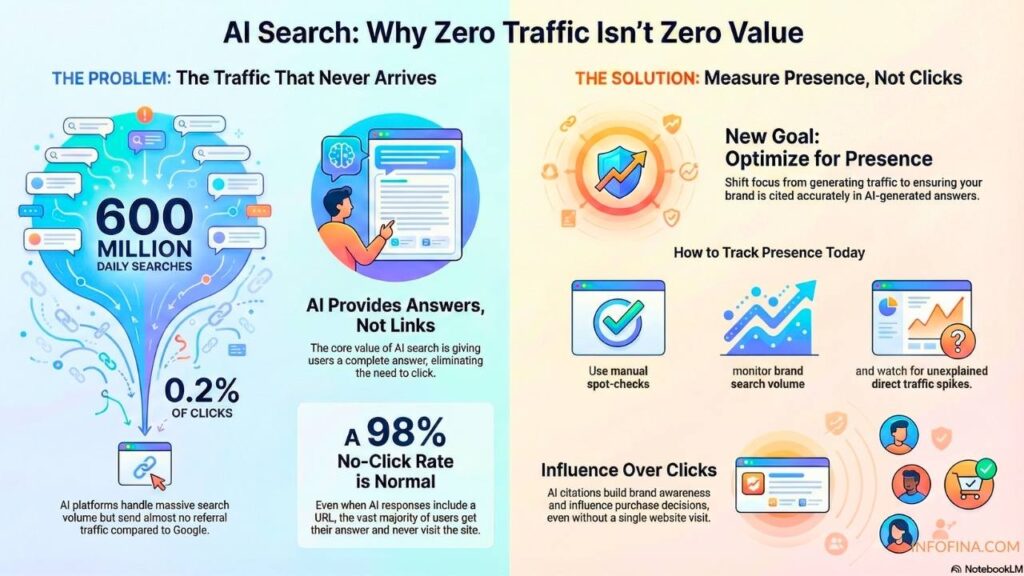
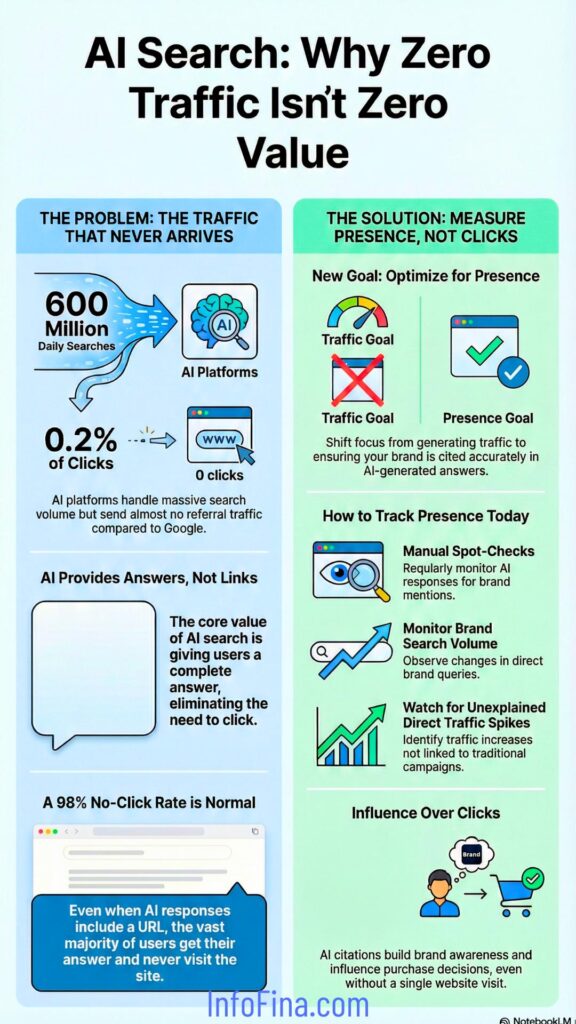
ChatGPT processes 2.5 billion prompts every day. About 24% are search queries. That is 600 million searches.
But ChatGPT sends only 0.2% of total web referral traffic compared to Google’s 42%.
The gap is not usage. The gap is infrastructure design.
When someone asks ChatGPT “What’s the best project management tool for remote teams?” the system answers directly. It synthesizes information. It provides recommendations. It explains tradeoffs.
The user gets what they need without clicking anything.
This is not a bug. This is the entire value proposition.
The Conversion Rate That Breaks Analytics
Here is the measurement problem in one data point.
When ChatGPT displays a URL in a response, 185,000 conversation impressions generate approximately 3,800 clicks. That is a 2% conversion rate.
Count multiple URL appearances within the same conversation and the click-through rate drops to 0.8%.
Your content gets cited. People see your brand name. They read your insights. They trust your expertise enough that an AI system referenced you as a credible source.
And 98% of them never visit your site.
Traditional analytics calls this failure. The new reality calls this normal distribution.
What We Actually Measure Now
I will be honest about this. We are mostly flying blind and using proxy metrics that feel like guesswork.
Google Analytics does not track ChatGPT citations. There is no referrer data even when these platforms do link out. Search Console does not separate AI Overview impressions from regular search results yet.
There is no “AI Citation Console” telling you how often Perplexity mentioned your brand this month.
So what are people actually doing?
Manual Spot-Checking
You search your target queries in ChatGPT, Perplexity, Gemini, and Claude every week. You track whether you get mentioned. Whether you are the primary source or buried in fourth position. What exact content gets cited.
It is tedious. It does not scale. But it is the most direct signal available.
Brand Search Volume as Proxy
The theory goes like this. If AI tools cite you, people will Google your brand name to learn more.
You watch for branded search traffic increases. You track “brand name + topic” query growth in Search Console.
The problem is correlation does not equal causation. Brand search spikes happen for dozens of reasons.
Direct Traffic Spikes
When direct traffic jumps without explanation, you assume some portion comes from people copying URLs out of AI responses. These platforms often strip referrer data, so the visit shows up as direct.
Some people add UTM parameters to URLs in their content hoping AI tools preserve them: yoursite.com/article?utm_source=ai-discovery
This rarely works. Large language models often clean URLs before displaying them.
Emerging Citation Tracking Tools
New platforms like Profound are trying to track citation frequency by running automated queries. You feed them your keyword list. They query multiple AI tools. They report citation rates.
The limitation is cost and coverage. The data basically says “we checked 500 times this month and you appeared in 47 responses.”
Better than nothing. Not exactly comprehensive analytics.
Inference from Absence
You track Google organic traffic declining while impressions stay flat or grow.
The gap between impressions and clicks represents probable zero-click extractions and AI Overview answers. People saw your content in some form. They got their answer. They moved on.
The Measurement Infrastructure Does Not Exist Yet
Right now, optimizing for AI citations feels like doing SEO in 2003 before Google Analytics existed.
You make changes. You manually check if they worked. You use indirect signals. You wait for the platforms to build proper measurement tools.
What would actual measurement look like?
OpenAI, Anthropic, and Perplexity offering a “Citation Console” for verified content owners. Server logs showing “AI bot” traffic separately from Googlebot. Standardized referrer headers when AI tools link out.
None of that exists today.
So when someone claims “we increased AI citations 61%” they are probably measuring manual spot-checks across 50 to 100 test queries. Not comprehensive analytics.
Why Zero Traffic Is Not Zero Value
A potential customer asks ChatGPT for vendor recommendations in your category.
Your company gets cited as one of three options. The AI explains your differentiation accurately. It mentions your pricing model. It describes which use cases you handle best.
The person never clicks through to your site. But three weeks later they request a demo. When your sales team asks how they heard about you, they say “research.”
That attribution never connects back to the AI citation.
Your analytics show zero AI traffic. Your pipeline shows a qualified lead who already understands your positioning. The measurement system missed the entire journey.
This is happening at scale. AI platforms influence purchase decisions, brand awareness, and consideration sets without generating traditional traffic metrics.
The Shift From Clicks to Presence
The old question was “how many people visited our site?”
The new question is “how often do we get cited when our audience asks questions in our domain?”
You are not optimizing for traffic anymore. You are optimizing for presence in the answer.
When someone asks about your topic area, does your brand appear? Do you get positioned accurately? Are you the primary source or a footnote?
These questions matter more than click-through rate.
Because the person asking ChatGPT about project management tools is not comparison shopping. They are trying to understand the landscape before they even know which vendors to evaluate.
If you are absent from that conversation, you are absent from their consideration set. If you are present, you have influence regardless of whether they click.
What This Means for Your Strategy
Stop obsessing over AI referral traffic in your analytics dashboard.
Start tracking citation frequency through manual spot-checks or emerging tools. Monitor branded search volume for correlation signals. Watch for direct traffic patterns that might indicate AI discovery.
But most importantly, shift your content strategy from traffic generation to citation optimization.
Create content that AI systems can extract and cite cleanly. Use structured assertions. Lead with entity clarity. Provide original data that did not exist before you published it.
The measurement infrastructure will catch up eventually. OpenAI will build citation dashboards. Perplexity will offer verified brand accounts with analytics. Google will separate AI Overview impressions in Search Console.
Until then, you are navigating with incomplete instruments.
Your zero traffic number is not failure. It is the reality of how these systems work. The question is not whether people click. The question is whether you show up when it matters.
And that requires measuring presence, not traffic.