
 DeepSeek V4 launched with day-zero support for Huawei Ascend chips, demonstrating that frontier AI development no longer requires Nvidia hardware.
The model activates only 49 billion of 1.6 trillion parameters while maintaining competitive performance, proving efficiency beats brute-force scaling. This shifts AI competition from who has the best chips to who builds the most cost-effective architecture.
Video – Why did DeepSeek V4 just shocked the AI industry?
Core Findings:
- DeepSeek V4 runs entirely on Chinese domestic chips (Huawei Ascend, Cambricon), eliminating Nvidia dependency
- Uses 27% of inference FLOPs and 10% of KV cache memory compared to V3 at 1 million token context
- Hardware independence transforms from theoretical hedge to deployed capability across major Chinese tech companies
- Cost per query becomes primary competitive variable as multiple providers reach human-level performance
DeepSeek released V4 on Friday. The announcement buried the lead.
The model runs with day-zero integration on Huawei Ascend chips. Not eventual compatibility. Not beta support. Full production deployment.
This is not about features. This is infrastructure realignment.
What Changed: Hardware Dependency is No Longer Structural
Frontier AI development has meant Nvidia dependency for two years. Every major lab built on CUDA. Every scaling roadmap assumed H100 access. Export controls were positioned as creating permanent advantage through hardware restriction.
That assumption just broke.
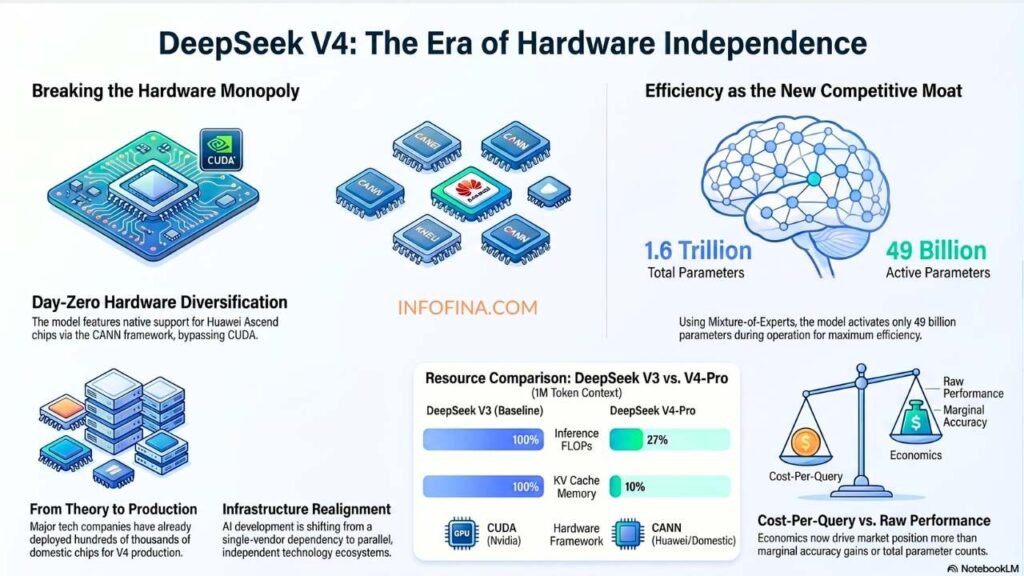
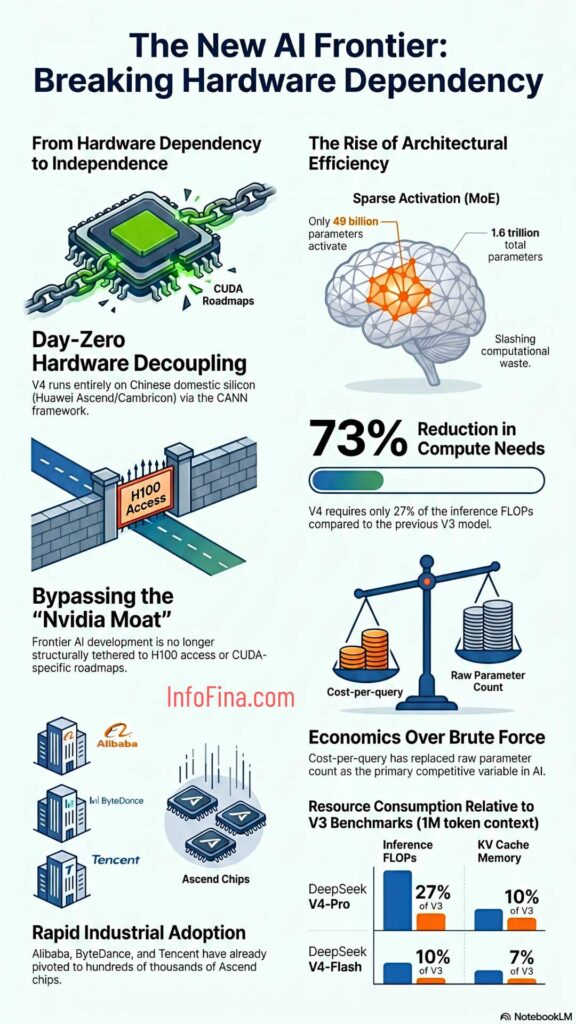
DeepSeek V4 operates entirely on Chinese domestic silicon. Huawei Ascend. Cambricon. The architecture migrated from CUDA to the CANN framework. Alibaba, ByteDance, and Tencent ordered hundreds of thousands of Ascend chips in recent weeks.
Bottom line: Hardware independence moved from contingency plan to operational reality.
Why This Matters: Efficiency Replaced Brute Force
V4-Pro holds 1.6 trillion parameters. During operation, only 49 billion activate.
At 1 million token context, the model needs 27% of the inference FLOPs and 10% of the KV cache memory compared to DeepSeek V3. The Flash version drops those numbers to 10% of FLOPs and 7% of cache.
Cost per query is replacing raw performance as the primary competitive dimension. When multiple providers hit human-level capability on common tasks, deployment economics matter more than marginal accuracy gains.
You no longer need frontier-class infrastructure costs to run frontier-class models.
Key point: Architectural efficiency now determines market position more than parameter count or chip access.
Strategic Implications: What This Means for Your Planning
For infrastructure builders: Hardware diversification moved from optional to required. Single-vendor dependency creates execution risk that did not exist six months ago. Your deployment strategy needs to work across chip architectures, not optimize for one.
For capital allocators: The premise that U.S. labs maintain decisive technical lead through hardware access needs revision. Competitive parity is arriving faster than export policy anticipated. The moat is narrowing in real time.
For product roadmap planning: Ultra-long context windows (1 million tokens) are becoming baseline capability, not premium feature. Your assumptions about retrieval-augmented generation and context management need updating. The architecture patterns that worked last quarter are already outdated.
Key point: The strategic assumptions built into your 2025 planning are being invalidated by deployment realities in early 2026.
The Underlying Pattern: Constraints Accelerate Innovation
Export controls were designed to slow AI development outside controlled ecosystems. The mechanism was hardware restriction. The theory was that cutting off access to advanced semiconductors would create persistent capability gaps.
The actual outcome: accelerated investment in alternative hardware stacks and architectural efficiency improvements.
DeepSeek demonstrated that competitive performance does not require cutting-edge Western semiconductors. That was the theoretical proof. V4 converts theory into deployed infrastructure serving millions of users across major commercial platforms.
Geographic decoupling of advanced AI development is moving faster than policy frameworks anticipated. Parallel technology ecosystems are forming.
Not capability gaps. Not temporary workarounds. Independent infrastructure stacks with comparable performance characteristics.
Constraints forced efficiency. Efficiency became competitive advantage.
Key point: Strategic restrictions intended to maintain lead position are producing the opposite effect by creating economic pressure that drives architectural innovation.
Frequently Asked Questions
How does DeepSeek V4 work on non-Nvidia chips?
DeepSeek V4 uses the CANN framework instead of CUDA, allowing deployment on Huawei Ascend and Cambricon processors. The architecture was redesigned for hardware flexibility rather than optimized for a single vendor.
What is mixture-of-experts architecture?
Mixture-of-experts activates only a subset of model parameters for each query. V4-Pro has 1.6 trillion total parameters but uses only 49 billion during operation, reducing computational requirements without sacrificing performance on most tasks.
Why does a 1 million token context window matter?
Million-token context allows processing entire books, large codebases, or comprehensive document sets in a single session without losing coherence. This reduces complexity in retrieval systems and changes how AI applications handle information.
Does this mean export controls failed?
Export controls created the intended hardware restrictions. The unintended consequence was accelerated development of alternative chip ecosystems and efficiency-focused architectures that achieve comparable results with less advanced semiconductors.
How much cheaper is DeepSeek V4 to run?
V4 requires 27% of the inference FLOPs and 10% of KV cache memory compared to V3 for the same context length. The Flash version drops to 10% of FLOPs and 7% of cache, translating to significantly lower per-query costs.
Are Western AI labs at risk of losing their lead?
The technical performance gap is narrowing faster than expected. Hardware access no longer guarantees decisive advantage. The competitive dimension is shifting toward deployment economics and architectural efficiency rather than raw capability.
What should companies do about hardware dependency?
Build deployment strategies that work across multiple chip architectures. Single-vendor dependency creates risk as alternative hardware ecosystems mature. Test compatibility with diverse infrastructure options before you need them.
How quickly are Chinese companies adopting Ascend chips?
Alibaba, ByteDance, and Tencent ordered hundreds of thousands of Ascend chips in recent weeks following V4’s release. Adoption is moving from experimental to production scale across major commercial platforms.
Key Takeaways
- Hardware independence in frontier AI moved from theory to deployed production capability with DeepSeek V4’s Huawei Ascend integration
- Architectural efficiency (27% of inference FLOPs, 10% of cache vs. V3) now determines competitive position more than access to cutting-edge chips
- Cost per query is replacing raw performance as primary competitive variable as multiple providers reach human-level capability
- Geographic decoupling of AI development is accelerating faster than policy frameworks anticipated, creating parallel ecosystems rather than capability gaps
- Strategic restrictions designed to maintain advantage are producing unintended consequences by forcing efficiency innovations that become competitive strengths
- Companies need multi-architecture deployment strategies immediately as single-vendor hardware dependency now carries execution risk