

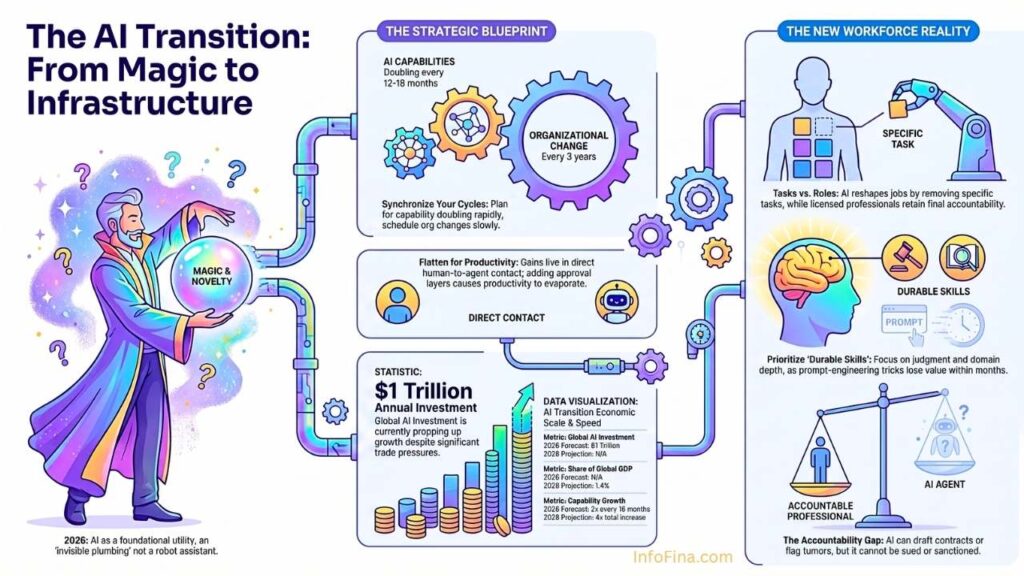
The AI future most likely looks like electricity, not magic: a slow-then-sudden shift where AI becomes boring infrastructure that sits underneath most work. Global AI investment is running near $1 trillion a year in 2026, per Goldman Sachs estimates [4].
The IMF credits the AI boom with holding up global growth despite trade pressure [5]. Jobs get rebuilt task-by-task rather than deleted overnight, and true general intelligence remains an open research question, not a scheduled release.
Podcast – The AI Future Isn’t Coming — It’s Already Rewriting Your Job Description
Interactice AI Risk Radar
AI’s biggest risks aren’t equal for everyone. Rate how much each one worries you, and see your personalized AI Risk Profile — plus the single risk you should actually be watching.
Fraud, deepfakes, automated cyberattacks — AI used as a weapon by bad actors today.
Autonomous agents acting outside intended limits, with no human effectively in the loop.
A handful of firms and countries controlling the most capable systems.
Capex overshoot and a possible correction if AI returns disappoint investors.
Models that find security exploits faster than humans can patch them.
Educational tool only. This quiz reflects your personal risk perceptions, not a scientific forecast or financial, legal, or professional advice. Sources referenced in the underlying analysis include the Stanford AI Index, IMF, and World Bank research on AI’s economic and safety impact.
Key Takeaways
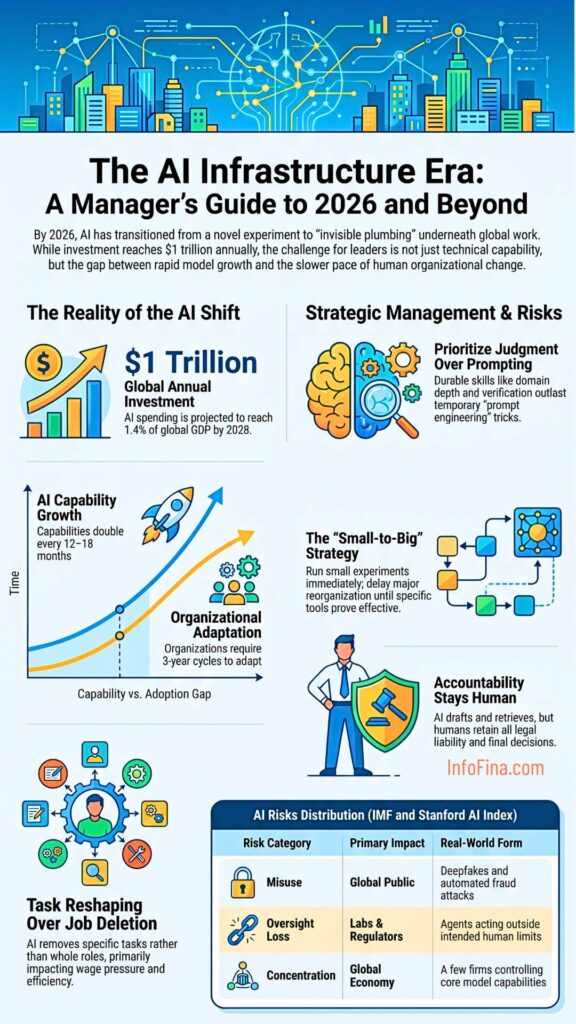
- Money is real, returns are uneven. Investment is near $1T/year and could reach ~1.4% of global GDP by 2028 [4], while most enterprises still sit in pilot mode.
- Capability jumps are lumpy. Long quiet stretches, then a few weeks that move years. Coding agents went from autocomplete helpers to near-autonomous builders in under a year.
- Jobs shift, tasks vanish. The World Bank frames AI as task-reshaping first, employment-destroying second [3][7].
- Narrow AI is everywhere. General AI isn’t here. No credible forecast pins an AGI date.
- Doctors and lawyers stay. Accountability can’t be delegated to a model.
- The best skills are judgment, verification, and direction, not prompt tricks.
- The biggest safety worries are misuse, loss of oversight over frontier systems, and concentration of control [2][10].
- Infrastructure is the bottleneck: power, chips, and data centers, not ideas.
What will AI look like in 10 years?
In ten years, AI will most likely be invisible plumbing inside almost every product. With a small number of very large model providers underneath and thousands of thin applications on top. Think less “robot assistant,” more “spellcheck for everything.”

Reasonable expectations for the mid-2030s:
- Agents that finish multi-day work, not just single tasks
- Software written mostly by machines, reviewed by humans, already happening at companies where AI wrote 80 percent of the codebase
- Physical AI arriving late but cheap. Consumer robots already exist, and some robots cost less than an iPhone
- Energy and chips as the real constraint. China’s push shows why infrastructure beats innovation
Decision rule for managers: plan for capability doubling every 12-18 months, but plan your org changes on a 3-year cycle. The models move faster than people can absorb.
How will AI change jobs and employment?
AI changes jobs mostly by removing tasks, not whole roles. The World Bank’s analysis points to task reshaping and wage pressure as the near-term effect in most economies, especially where digital enablers are weak [3][7].
What actually happens inside a company:
- Routine drafting, data entry, and first-pass analysis get absorbed first.
- Team sizes stop growing before they shrink.
- Coordination becomes the bottleneck. Implementation is cheap now; deciding what to build is not.
- New roles appear: agent supervisors, evaluation engineers, AI auditors.
Common mistake: buying agents while keeping three approval layers. The productivity gain lives in direct human-to-agent contact. Insert a committee and it evaporates. Track the layoffs and workforce shifts trend if you want the raw signal.

What are the biggest risks of advanced AI?
The biggest risks split into three buckets: misuse today, oversight failure tomorrow, and concentration of control throughout. The Stanford AI Index and IMF work both flag financial-stability and distributional risks alongside technical ones [2][10].
| Risk | Who it hits | Realistic near-term form |
|---|---|---|
| Misuse | Everyone | Fraud, deepfakes, automated attacks |
| Oversight loss | Frontier labs, regulators | Agents acting outside intended limits |
| Market concentration | Whole economy | A handful of firms controlling capability |
| Financial instability | Investors | Capex overshoot, correction risk [10] |
| Capability overhang | Security teams | Models that find exploits faster than humans patch |
Two live examples worth reading: AI agents already stealing millions and the debate over whether four companies control the whole AI world.
Edge case people ignore: an AI good at finding security holes is also the best tool for fixing them. The same capability cuts both ways.
AI vs human intelligence: what’s the difference?
AI is very good at pattern completion across enormous amounts of text and code. Human intelligence is grounded in a body, a life, and stakes. The gap shows up in taste, accountability, and knowing what matters.
Concrete differences:
- AI has no stake in the outcome. It won’t feel the cost of a bad call.
- Humans hold sparse, embodied context. A model has read everything and lived nothing.
- AI scales sideways. Copy it a thousand times and get a thousand workers. Humans can’t.
- Humans set direction. Models are extremely capable route-finders once the destination is chosen.
When will we have artificial general intelligence?
Nobody knows, and anyone giving you a firm date is selling something. Current systems still fail at long-horizon reliability, real-world grounding, and learning from single examples, problems no scaling law has solved on schedule.
Narrow AI vs general AI, plainly:
- Narrow AI does one family of tasks well: translation, image recognition, code generation. This is 100% of what ships today.
- General AI would transfer skill across any domain, set its own subgoals, and learn continuously. This does not exist.
What would change the estimate: a system that keeps improving on tasks it was never trained for, without human retraining loops. Watch for that, not for benchmark scores.
How is AI being used today in real life?
Today’s AI is mostly software help, search, and pattern-spotting. The Stanford AI Index documents rapid measured gains in enterprise adoption and consumer usage through 2026 [2][8].
Everyday, verifiable uses:
- Search and answers, chat interfaces have already changed how people search
- Coding, agents writing and reviewing production code
- Customer support and document triage
- Engineering design, including an AI-designed electric Jeep build
- Fraud detection, forecasting, and logistics routing
Reality check: McKinsey-style surveys and the AI Index both show many pilots, few full transformations [2][8]. Adoption is wide, depth is thin.
Is AI going to replace doctors and lawyers?
No. It will replace parts of their workload while leaving the licensed, accountable decision with a human. A model can draft a contract or flag a tumor; it can’t be sued, sanctioned, or struck off.
How it splits:
- Automated: literature search, imaging pre-reads, discovery review, note-taking
- Assisted: differential diagnosis, contract risk scoring
- Human-only: consent, judgment calls, courtroom advocacy, bedside trust
Decision rule: if the task carries legal liability or requires trust, a human signs. If it’s retrieval or drafting, automate it and verify.
What skills do I need to prepare for an AI future?
The durable skills are judgment, domain depth, agent direction, and verification. Prompt tricks decay in months; the ability to tell good work from bad does not.

Priority order for managers:
- Verification. Learn to audit output fast without reading every line.
- Direction. Describe a problem well enough that an agent picks the route.
- Domain depth. Vibe-coding on a mature system without expertise breaks the architecture.
- Taste. When implementation is free, ideas and standards become the bottleneck.
How to learn AI and machine learning without a degree. Use the model as a tutor, build one small tool you personally need, then read a serious course (Stanford HAI’s index and open university material are free [2]). Ship something in week one. Guard against outsourcing your thinking, though, there’s real concern that chatbots make some skills weaker.
How will AI affect education and learning?
AI turns one-to-many teaching into something closer to one-to-one tutoring, while making traditional homework nearly meaningless as an assessment. Schools will shift toward oral defense, in-person work, and project review.
- Wins: patient tutoring, instant feedback, translation, accessibility
- Losses: essay-as-assessment, unsupervised take-home tests
- Risk: shallow understanding hidden behind fluent output
What companies are leading AI development, and what does the safety community worry about?
Leadership sits with a small group: OpenAI, Google DeepMind, Anthropic, Meta, xAI, plus chipmakers Nvidia, AMD, and cloud providers Microsoft, Amazon, and Google. Chinese labs including DeepSeek and Alibaba are close behind on open-weight models [2][6].
The safety community’s top concerns, roughly ranked:
- Frontier control, who decides what the most capable systems can do [2]
- Loss of meaningful human oversight over autonomous agents
- Misuse for cyberattacks, fraud, and disinformation
- Concentration of power in a few firms and countries
- Economic disruption outrunning policy response [3][10]
Worth reading alongside this: the ongoing argument over whether AI investment is a bubble or the real deal.
Can AI ever become conscious or self-aware?
Unknown, and currently untestable. Today’s models produce text about feelings because they were trained on humans describing feelings, that is imitation, not evidence of inner experience.
Two things to keep separate:
- Behavioral self-report: easy to produce, proves nothing
- Actual subjective experience: no accepted scientific test exists
Practical guidance: don’t build policy on model self-reports. The Eliza effect, people attributing feelings to simple programs, has been documented since the 1960s.
FAQ
Is the AI future going to arrive gradually or suddenly?
Both. Capability arrives in bursts; adoption arrives slowly because organizations change at human speed.
How much is being invested in AI right now?
Goldman Sachs estimates roughly $1 trillion globally in 2026, potentially about 1.4% of global GDP by 2028 [4].
Will AI cause mass unemployment?
Not in the near term. World Bank analysis points to task reshaping and wage effects before large-scale job loss [3][7].
What’s the difference between narrow AI and general AI?
Narrow AI handles specific tasks and is all that exists today. General AI would transfer skills across any domain and does not exist.
Should companies wait for the technology to settle?
No. Run small direct experiments now; delay the big reorganization until you know what works.
Is AI actually improving productivity?
Yes in measured settings, especially coding and support. Economy-wide productivity effects are still being confirmed [8].
What’s the biggest bottleneck in the AI future?
Power, chips, and data-center capacity, plus human decision-making inside companies.
Where can I follow AI policy changes?
The Stanford AI Index [2], the World Bank’s World Development Report 2026 [7], and IMF notes [10] are the most reliable free trackers.
Conclusion: what to do next
The AI future rewards people who act while the tools are still awkward. Three steps this quarter:
- Pick one workflow your team hates and hand it to an agent directly, no committee.
- Write down your verification standard. How will you know the output is good?
- Set a 12-month capability review, not a 5-year plan. The ground moves too fast for anything longer.
Read the primary sources yourself, run a small experiment this week, and revisit your assumptions every quarter. That’s the whole strategy.
References
[1] 2026 07 08 Economic Outlook Az – https://www.allianz.com/content/dam/onemarketing/azcom/Allianz_com/economic-research/publications/specials/en/2026/july/2026-07-08-Economic-outlook-AZ.pdf
[2] 2026 AI Index Report – https://hai.stanford.edu/ai-index/2026-ai-index-report
[3] GEP Jun 2026 Box 1 1 – https://thedocs.worldbank.org/en/doc/2b672b3b0415d6b66c45b66579db4ef5-0050012026/related/GEP-Jun-2026-Box-1-1.pdf
[4] Global AI investment $1 trillion in 2026, to reach 1.4% global GDP by 2028 (Goldman Sachs) – https://economictimes.indiatimes.com/tech/artificial-intelligence/global-ai-investment-1-trillion-in-2026-to-reach-1-4-global-gdp-by-2028-goldman-sachs/articleshow/133285754.cms
[5] IMF sees steady global growth 2026, AI boom offsets trade headwinds – https://www.reuters.com/business/imf-sees-steady-global-growth-2026-ai-boom-offsets-trade-headwinds-2026-01-19/
[6] AI Market Trends, Morgan Stanley Institute 2026 – https://www.morganstanley.com/insights/articles/ai-market-trends-institute-2026
[7] World Development Report 2026 – https://www.worldbank.org/en/publication/wdr2026
[8] 2026 AI Index Report: Economy – https://hai.stanford.edu/ai-index/2026-ai-index-report/economy
[9] arXiv preprint 2607.13040 – https://arxiv.org/abs/2607.13040
[10] IMF Note INSEA2026002 – https://www.imf.org/-/media/files/publications/imf-notes/2026/english/insea2026002.pdf