
AI infrastructure means the GPUs, networking, data centers, cooling, and power systems that train and run AI models. Large models require thousands of chips working together.
Fundamentally changing how buildings, budgets, and power grids get planned. Costs range from tens of millions to tens of billions of dollars. Electricity is now often the biggest recurring expense.
Podcast – AI Companies Are Now Competing With Cities for Electricity
AI Infrastructure Interactive Quiz
AI Infrastructure: GPU Superclusters, Data Centers & Energy Costs
Test your understanding of the hardware, costs, and power demands driving modern AI — 10 questions, instant feedback.
Key Takeaways
- AI infrastructure covers GPUs, networking, data centers, cooling, and power as one integrated system.
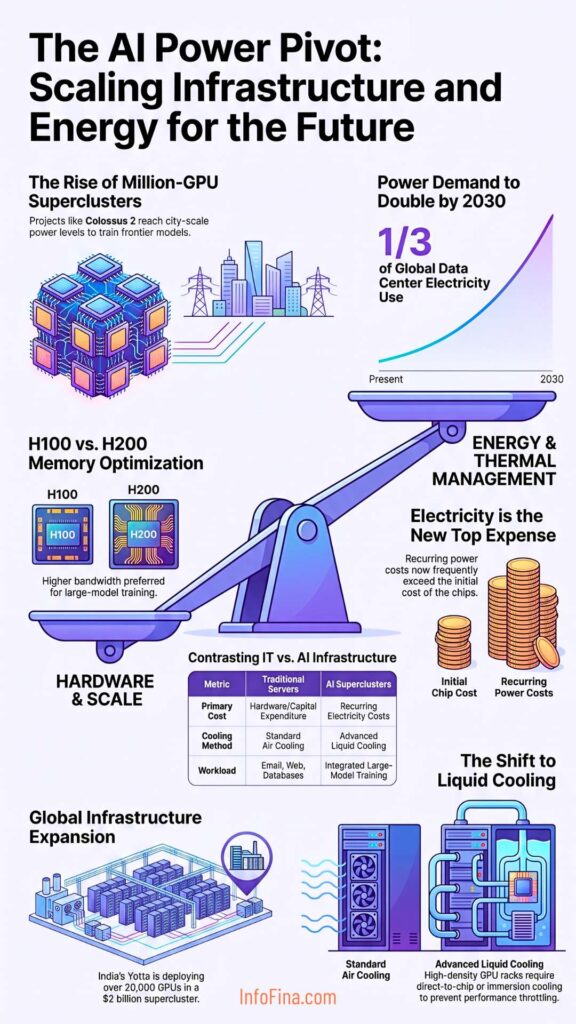
- Superclusters now reach million-GPU scale, like xAI’s Colossus 2 project. [1]
- AI-optimized servers account for roughly one-third of global data center power today. [4][5]
- The H200 offers more memory bandwidth than the H100, speeding up large-model training. [2]
- Renting cloud GPUs suits short or unpredictable projects; buying pays off over two-plus years.
- Electricity, not chip cost, is now the main line item in AI budgets. [7][8]
- Cooling is shifting from air to liquid because AI racks run far hotter than normal servers. [8]
- Data center power demand is forecast to more than double by 2030. [9]

What Is AI Infrastructure and Why Does It Matter?
AI infrastructure is the complete hardware and facilities stack needed to train and run AI models. It covers GPUs, high-speed networking, servers, storage, data center buildings, cooling, and power supply.
Companies need it because large AI models cannot run on standard office servers. Training demands thousands of chips communicating at extremely high speed. Inference—serving the model to users—requires steady, always-on capacity. Networking connects GPUs so they act as one giant computer.
The most common planning mistake is buying GPUs first and treating power and cooling as an afterthought. A data hall built for standard servers rarely supplies enough electricity or cooling for AI racks. That order almost always causes expensive delays.
How Much Does an AI Data Center Cost?
Building an AI data center typically costs from a few hundred million dollars for a mid-size facility to tens of billions for a gigawatt-scale campus.
Power infrastructure often costs as much as the chips themselves. Key cost drivers include GPUs and servers, substations and backup generators, liquid cooling systems, land, and networking.
To calculate ROI, compare cost per useful GPU-hour against what that compute earns or saves. Utilization rate matters more than raw GPU count.
A cluster sitting idle destroys returns quickly. Renting cloud GPU time works better for short or unpredictable projects. Buying hardware pays off when the workload is constant and runs for two or more years.
GPU Superclusters vs. Traditional Servers
GPU superclusters link thousands to millions of GPUs with ultra-fast networking so they train one model in concert. Traditional servers handle web apps, databases, and email—tasks that need no constant chip-to-chip communication.
AI training requires the opposite: every GPU must share data with every other almost instantly.

Projects like xAI’s Colossus 2 are being built at city-scale power levels with roughly one million GPUs. [1] Long-distance “stretched” superclusters, linking data centers across regions as one machine, are now moving from concept to commercial deployment. [3]
Outside the US, India’s Yotta is deploying over 20,000 Nvidia Blackwell Ultra GPUs in a supercluster worth more than $2 billion. [10] Training a GPT-4-class model typically requires thousands to tens of thousands of GPUs running for weeks or months. [1][10]
What’s the Difference Between Nvidia H100 and H200 GPUs?
The H200 improves on the H100 mainly through memory: faster, larger high-bandwidth memory lets it process bigger models and larger batches without slowing down. [2]
New large-scale builds now favor the H200 as the H100 is phased out for frontier clusters. Competition is intensifying, with AMD pushing high-memory chips against Nvidia’s full-rack AI systems. [2]
| Feature | H100 | H200 |
|---|---|---|
| Best for | General AI training | Large-model training, memory-heavy inference |
| Memory bandwidth | Lower | Higher |
| Build status | Being phased out | Preferred for new large-scale clusters |
How Much Electricity Do AI Data Centers Use?
AI-optimized servers already account for roughly one-third of global data center electricity use, and that share is growing fast. [4][5] Data centers overall approach about 2% of global electricity consumption.
AI is expected to push total data center power demand to double by 2030. [9] Gartner forecasts that AI servers will surpass conventional hardware in power use by 2027. [2]
Electricity is now often the largest recurring cost in AI training, ahead of chip costs. Higher power prices or grid constraints force companies to slow rollouts, delay projects, or relocate facilities to cheaper-power regions.
This is why AI superclusters increasingly compete with cities for grid capacity. Most new AI facilities use liquid cooling—direct-to-chip cold plates or immersion systems.
Because AI racks generate far more heat per square foot than standard servers. [8] Air cooling still works for lighter inference workloads, but dense GPU training clusters need liquid cooling to avoid throttling performance.

Common Mistakes When Building AI Infrastructure
Treating power and cooling as an afterthought causes the most expensive delays. Other frequent mistakes include underestimating inter-GPU networking bandwidth.
Buying hardware before securing grid capacity, ignoring utilization rates that leave expensive chips idle, and deferring cooling upgrades until thermal limits hit within a year.
For background on why hardware has become the deciding factor in AI competition. See this analysis of how hardware won over software in AI, and browse ongoing coverage under the infrastructure tag and data center tag.
FAQ
Q: What is AI infrastructure?
A: AI infrastructure is the combined hardware and facilities needed to train and run AI models at scale. It includes GPUs, high-speed networking, data centers, cooling, and power systems. Companies need it because large AI models cannot run on standard servers.
Q: Do I need a GPU supercluster to use AI?
A: No. Most businesses access pre-trained models through cloud APIs without owning a cluster. Superclusters matter mainly for companies training new frontier models from scratch. Fine-tuning existing models typically requires far fewer GPUs.
Q: Is renting GPU cloud time better than buying hardware?
A: Renting works better for short or unpredictable workloads lasting a few months. Buying hardware pays off when usage is constant and expected to run for two or more years. Utilization rate is the key variable in that decision.
Q: Why is electricity the top cost concern for AI data centers?
A: AI-optimized servers account for roughly one-third of global data center power today. [4][5] That share is growing rapidly as more AI hardware comes online. Higher electricity prices can force companies to delay projects or relocate new builds.
References
- Xai Colossus 2 1 Million Gpu News 2026
- Ai Servers Will Consume More Power Than Conventional Data Center Hardware By 2027 Gartner Forecasts
- Drivenets Announces Industrys First Commercial Deployment Of A Long Distance Scale Across Ai Supercluster
- Ai Data Center Energy Consumption 2026
- Ai Data Center Energy Consumption Statistics
- Ai Data Center Power Crisis 2026
- Genai Power Consumption Creates Need For More Sustainable Data Centers
- Ai Data Center Power Demand Grid Constraints Energy Resilience
- S P Webinar Data Center Power Demand To More Than Double By 2030 102727689
- Yotta To Deploy 20 736 Nvidia Blackwell Ultra Gpus In Over 2 Billion Supercluster
- Growing Energy Demand Of Ai Data Centers 2024 2026
- Data Centre Electricity Use Surged In 2025 Even With Tightening Bottlenecks Driving A Scramble For Solutions
- The Us Now Uses Nearly 40 Of The Worlds Data Center Electricity
- Data Center Hardware Highlights July 2026
- Amd Expected To Launch Next Generation Of Ai Infrastructure To Challenge Nvidia