
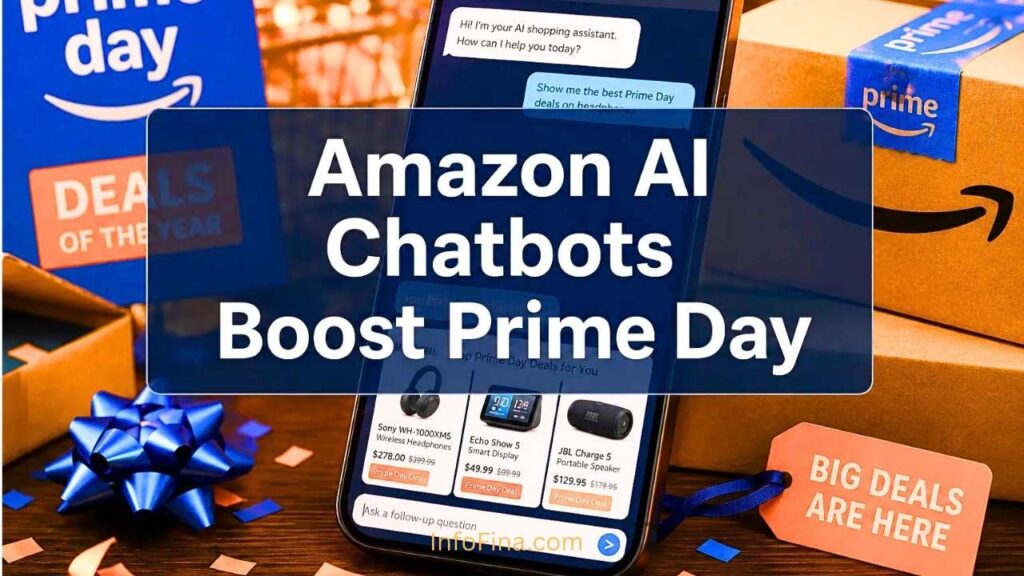
Amazon AI chat is an artificial intelligence-powered shopping assistant built into the Amazon app and website. During Prime Day, it guides shoppers to deals, answers product questions, and speeds up purchases — directly lifting Amazon’s conversion rates.
Podcast – Amazon Trained an AI to Win Prime Day Before It Even Starts
Do You Know Your Secret Shopping Personality?
What’s Your Amazon Shopping Personality?
6 quick questions reveal which of 5 shopper types you are — and exactly how to use Amazon AI chat (Rufus) for your style.
What Is Amazon AI Chat and How Does It Work?
Amazon AI chat refers primarily to Rufus, Amazon’s generative AI shopping assistant launched in 2024. Rufus lives inside the Amazon app and website.
You type a question and it responds with product suggestions, comparisons, or direct answers. It feels less like a search bar and more like a conversation with a knowledgeable friend.
Rufus runs on a large language model fine-tuned for shopping tasks. Natural language processing lets it understand conversational questions clearly.
Ask “What’s a good gift for a 10-year-old who loves science?” and it delivers targeted, relevant results instantly. A personalization engine pulls from your order history, wish lists, and browsing behavior.
Product catalog integration means it searches millions of listings in real time. The result is a shopping assistant that knows the catalog and knows you.

How Amazon Uses Chatbots During Prime Day
Prime Day creates a specific and predictable problem for shoppers. Millions of deals appear over 48 hours, and decision fatigue sets in fast.
Rufus solves this by narrowing choices quickly and efficiently. Shoppers can type “Show me Prime Day deals on air fryers under $80” and get targeted results immediately.
The chatbot handles quick product comparisons, tracks stock alerts, assists with cart additions, and deflects routine FAQ traffic away from human agents.
Fewer abandoned carts and faster decisions translate directly into completed purchases for Amazon.
Does Amazon AI Chat Actually Increase Sales?
Yes, based on Amazon’s own reporting and broader industry data on retail chatbots.
Amazon confirmed Rufus was handling hundreds of millions of customer interactions within months of its wider rollout. Retailers using AI chat consistently see measurable reductions in cart abandonment.
The mechanism is clear: shoppers who receive a confident recommendation buy faster and with less hesitation. Rufus also keeps shoppers inside Amazon’s ecosystem instead of bouncing to a competitor site to research.
When the chatbot answers a comparison question on the spot, the shopper stays on Amazon. Upsell opportunities arise naturally when it suggests accessories or bundle deals alongside a main item.

Amazon Chatbot vs. Other Retail Chatbots
Amazon’s biggest competitive advantage over rivals is data depth. Years of purchase history, product reviews, and browsing signals give Rufus more context than any competing platform. Here’s how the main options compare:
| Feature | Amazon Rufus | Walmart AI Assistant | Google Shopping AI |
|---|---|---|---|
| Purchase history integration | ✅ Deep | ✅ Moderate | ⚠️ Limited |
| Multi-retailer product search | ❌ Amazon only | ❌ Walmart only | ✅ Yes |
| Returns and order help | ✅ Yes | ✅ Yes | ❌ No |
| Conversational depth | High | Moderate | High |
The core tradeoff: Rufus only works within Amazon’s ecosystem. For cross-retailer price comparison, Google Shopping AI is the stronger tool. Understanding each tool’s limits saves time during high-traffic sale events.
What Rufus Can and Cannot Do
Rufus handles far more than deal discovery during Prime Day. It can initiate returns, explain the return window for a specific item, and generate a shipping label.
It adds items to your cart, highlights active coupons, confirms Prime shipping eligibility, and pulls up real-time order tracking when you ask “Where is my order?” For straightforward tasks, you don’t need to contact anyone.
Its limits matter equally. Rufus cannot process payments or apply gift card balances to an order. It cannot override Amazon’s policies or individual third-party seller return terms.
It cannot escalate to a human agent on its own — you must request that separately through the Help menu.
For billing disputes and account security issues, Amazon’s human support team remains essential.
This mirrors a broader pattern in AI tools — as explored in our piece on how Claude took business customers from ChatGPT — where AI excels at information and guidance but falls short when authority or judgment is required.

How Accurate Are Amazon AI Chat Product Recommendations?
Rufus performs well for large, well-reviewed product categories on Amazon. It works best when you provide a specific use case, such as “headphones for running in the rain.”
Your purchase history sharpens its answers with relevant personal context. It performs worse for niche products with thin review data and for very recent releases not yet fully indexed.
The chatbot synthesizes Amazon listing data and customer reviews — it is not an independent product tester.
For high-stakes purchases over $100, cross-check Rufus suggestions with external review sources before buying. Treating its recommendations as definitive expert reviews is one of the most costly mistakes shoppers make during Prime Day.
Common Mistakes People Make With Amazon Chatbots
Vague questions reliably produce generic and unhelpful answers. “What should I buy?” gets a weak, broad response.
“What’s the best Prime Day deal on robot vacuums under $200?” gets a specific, actionable one. Many shoppers underuse the chatbot for returns, which Rufus can process in under a minute.
Some rely on it for medical or safety-critical product decisions, which it is not qualified to make. Over-reliance on AI recommendations can gradually erode your own decision-making instincts.
A dynamic explored in our piece on whether AI chatbots are making users weaker at decision-making.

Amazon Chatbot Not Responding — What to Do
If Rufus stops working, start by refreshing the Amazon app. Check your internet connection next, since Rufus needs a live connection to fetch catalog and account data.
Clearing the app cache on Android (Settings > Apps > Amazon > Clear Cache) resolves many slowdowns. During Prime Day specifically, high traffic can extend response times noticeably.
Wait 30 seconds and try rephrasing your question more simply and directly. If the app chatbot fails entirely, switch to Amazon.com on a desktop browser as a reliable fallback.
Alternatives and Cost
Rufus is completely free for all Amazon customers. No Prime membership is required to use the chat feature. Amazon absorbs the cost as part of its platform retention strategy.
More time on Amazon means more purchases and more revenue. The chatbot is a conversion tool, not a standalone product with its own pricing.
For genuine alternatives: Google Shopping AI handles cross-retailer price comparisons well. Perplexity AI is strong for research-heavy purchases where you want cited sources.
ChatGPT with browsing handles open-ended product research not tied to a single retailer. None of these tools match Rufus for Amazon-specific personalization.
For broader context on where retail AI is heading, see our analysis of whether OpenAI has conceded ground to Google in the AI assistant race.

FAQ
Does Rufus remember my previous shopping conversations?
Within a session, Rufus maintains full context of the ongoing conversation. Across sessions, it uses your account data but does not store a reviewable conversation history. You can limit data personalization through your Amazon account’s privacy settings, though this reduces recommendation quality.
Can sellers pay to influence what Rufus recommends?
Amazon states that Rufus recommendations are based on relevance and customer data, not paid placement. Sponsored products can still appear in adjacent search results alongside Rufus answers. Knowing the difference helps you evaluate suggestions more clearly during high-pressure sale events like Prime Day.
Is Amazon AI chat available outside the United States?
As of 2026, Rufus is available in the US, UK, India, Canada, and several other markets. The rollout continues expanding gradually to additional regions. Check the Amazon app in your country for current availability and feature parity.
Can I use Rufus to track a package?
Yes. Ask “Where is my order?” and Rufus pulls up your most recent shipment’s tracking status directly within the chat. For orders from third-party sellers, tracking detail may vary depending on the seller’s logistics setup and whether a tracking number was provided.
Conclusion
Rufus is one of the most practically useful AI shopping tools available in 2026. During Prime Day, it cuts through deal overload, accelerates purchase decisions, and keeps shoppers from leaving Amazon to research elsewhere.
All of which directly translate into completed purchases. Open the Amazon app before Prime Day starts and try asking a specific product question to see what it can do.
Use it for returns first if you’ve never tried it — that’s the fastest way to understand its real value. For high-stakes purchases, use it as a starting point and cross-check with external sources before you commit.