

Amazon AI, delivered through Amazon Web Services (AWS), is the world’s largest cloud AI platform. It gives businesses access to custom AI chips, managed services like Amazon Bedrock. And a full stack of tools for building machine learning models. In Q2 2026, AWS posted record revenue growth driven largely by surging AI demand. [3]
Podcast – Why AWS Is Winning the AI Race by Not Playing It
Which Cloud AI Platform Is Right for Your Business?
Which Cloud AI Platform Is Right for Your Business?
AWS, Microsoft Azure, or Google Cloud — each platform has a different strength. Answer 10 quick questions and find out which one fits your team, budget, and goals.
Disclaimer: This quiz is for informational and educational purposes only. Results are based on general platform characteristics and do not constitute professional IT consulting advice. Pricing, features, and availability change frequently — always verify directly with AWS, Microsoft Azure, and Google Cloud before making business decisions. Learn more at infofina.com.
Key Takeaways
- AWS describes its platform as the most comprehensive and price-competitive for generative AI. [1]
- The platform runs on three layers: infrastructure, Amazon Bedrock, and AI applications. [9]
- Custom chips — Trainium and Inferentia — cut training and inference costs. [2]
- Bedrock gives access to Anthropic Claude, Meta Llama, and other leading models. [9]
- Andy Jassy named AI infrastructure the primary growth engine in Q2 2026. [5]
- Both small businesses and enterprises can access Amazon AI with usage-based pricing.
- AWS leads competitors on infrastructure breadth; Azure leads on Microsoft integration. [10]

What Is Amazon AI and How Does It Work?
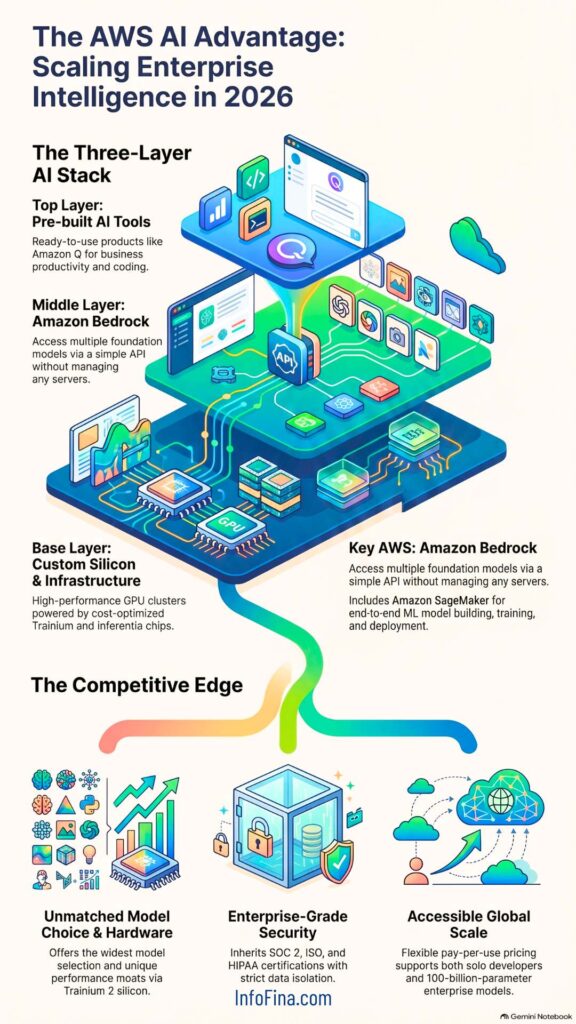
Amazon AI is AWS’s full collection of artificial intelligence and machine learning services. It operates through a three-layer stack that serves every level of technical expertise. [9]
At the base, AWS runs AI workloads on GPU clusters and custom silicon chips. The middle layer — Amazon Bedrock — lets developers call foundation models through a simple API.
No server management is required at all. The top layer includes pre-built tools like Amazon Q and industry-specific AI products.
A startup can use Bedrock with zero infrastructure setup today. A large enterprise can train a 100-billion-parameter model on a dedicated UltraCluster. [2] This range of scale is AWS’s defining advantage.
- Layer 1 – Infrastructure: EC2 GPU instances, Trainium chips, Inferentia chips, UltraClusters
- Layer 2 – Amazon Bedrock: Models from Anthropic, Meta, Cohere, AI21 Labs, Stability AI
- Layer 3 – Applications: Amazon Q, SageMaker, Rekognition, Polly, Lex
What Amazon AI Services Are Available Right Now?
AWS offers more than 30 distinct AI and ML services in 2026. The most widely used are listed below.
| Service | What It Does |
|---|---|
| Amazon Bedrock | Managed access to multiple foundation models via API |
| Amazon SageMaker | End-to-end ML model building, training, and deployment |
| Amazon Q | AI assistant for business productivity and coding |
| Amazon Rekognition | Image and video analysis at scale |
| Amazon Polly | Text-to-speech conversion in multiple languages |
| Amazon Lex | Conversational AI and chatbot building |
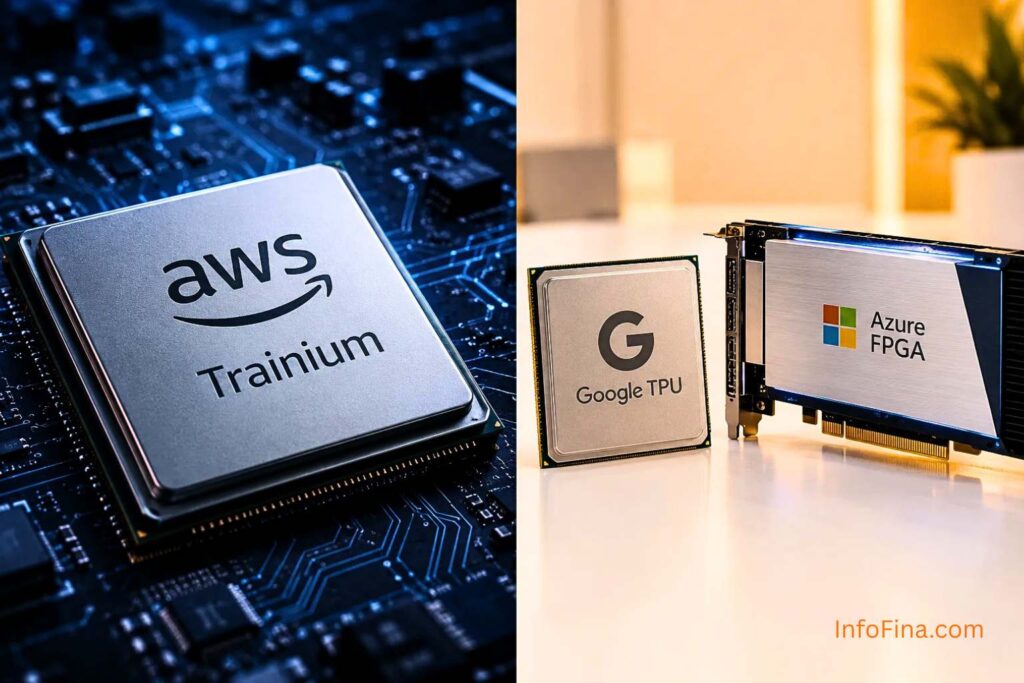
| AWS Trainium instances | Cost-optimised model training on custom silicon |
| AWS Inferentia instances | Cost-optimised model inference on custom silicon |

How Does Amazon AI Compare to Google Cloud AI and Microsoft Azure AI?
AWS leads on infrastructure depth and foundation model choice. Google Cloud leads on proprietary model quality with Gemini. Azure leads on enterprise Microsoft integration through its OpenAI partnership and Copilot ecosystem.
Choose AWS when you want the widest model selection, mature MLOps tooling via SageMaker, or large-scale training where custom chip pricing matters.
Choose Google Cloud for tight Gemini or Google Workspace integration. Choose Azure when your organisation already runs on Microsoft 365.
Futurum Research noted at AWS Summit NY 2026 that Trainium 2 represents a genuine performance moat for agentic AI workloads. Competitors have not yet matched it. [10]
Amazon AI Pricing and Costs for Businesses
AWS AI pricing is usage-based — you pay per API call, per compute hour, or per token processed. There is no flat subscription for most services.
- Bedrock API calls: Priced per 1,000 input/output tokens; rate varies by model
- SageMaker training: Billed per instance-hour; Trainium instances cost 30–40% less than equivalent NVIDIA GPU instances [2]
- Inferentia inference: AWS claims up to 40% lower cost per inference versus GPU instances [1]
The most common mistake teams make is underestimating data transfer and storage costs. Set billing alerts in AWS Cost Explorer from day one.
How to Get Started with Amazon AI on AWS
Basic use cases are up and running in under 30 minutes. Follow these steps to begin.
- Create an AWS account at aws.amazon.com — a free tier is available.
- Open the Amazon Bedrock console — no infrastructure setup is needed.
- Request model access for the foundation models you want — approval is usually instant.
- Run a test prompt in the Bedrock Playground to confirm access.
- Integrate via the AWS SDK in Python, JavaScript, or Java.
- Set billing alerts in AWS Cost Explorer before scaling to production.
For production ML workloads, SageMaker adds model versioning, pipelines, and deployment endpoints.
How Secure Is Amazon AI for Sensitive Data?
AWS AI services inherit AWS’s enterprise security framework. Applicable certifications include SOC 2, ISO 27001, HIPAA eligibility, and FedRAMP authorisation. [4]
AWS states that customer data processed through Bedrock is not used to train the underlying foundation models. [7]
Data stays within the customer’s own AWS environment and VPC. Key protections include encryption at rest and in transit, IAM role-based access control, and AWS PrivateLink to keep traffic off the public internet.
For healthcare, finance, or government workloads, AWS GovCloud regions offer additional isolation.
Amazon AI Limitations and What It Can’t Do
No platform is perfect. AWS has notable gaps businesses should understand before committing.
- No proprietary frontier model: AWS relies on third-party models through Bedrock; it has no equivalent to GPT-4o or Gemini 1.5 Pro.
- Complexity: SageMaker has a steep learning curve and can over-engineer simple use cases.
- Vendor lock-in: Deep AWS integration makes migration to other clouds expensive.
- Cost unpredictability: Token-based pricing can spike unexpectedly at scale.
- Regional availability: Not all Bedrock models are available in every AWS region.
Conclusion
Amazon AI leads the enterprise cloud AI market in 2026. Its three-layer stack, custom silicon infrastructure, and Bedrock’s multi-model access offer more flexibility than any single competitor. [9] [1]
The platform has real weaknesses: no proprietary frontier model, a steep SageMaker learning curve, and unpredictable costs at scale.
For organisations needing production-grade AI with enterprise security and global scale, AWS remains the default starting point.
Actionable next steps:
- Start with a free-tier Bedrock account to test models on your actual use case.
- Use SageMaker only when you need custom model training — don’t over-engineer early.
- Set billing alerts before any production workload goes live.
- Review AWS’s prescriptive guidance on enterprise-ready generative AI platforms before designing your architecture. [4]
FAQ
What is the difference between Amazon Bedrock and SageMaker?
Bedrock is for using existing foundation models — like Anthropic Claude or Meta Llama — without ML expertise. SageMaker is for building, training, and deploying your own custom machine learning models. Most mid-size companies end up using both tools for different purposes. Bedrock handles generative AI features; SageMaker handles any custom model work.
Does AWS have its own frontier AI model?
AWS does not offer a publicly available frontier foundation model. Instead, it focuses proprietary R&D on AI chips — Trainium and Inferentia — and provides access to third-party models through Amazon Bedrock. [2] For the most capable models, customers rely on Anthropic, Meta, and other partners via Bedrock.
Is Amazon AI data used to train Amazon’s models?
AWS states that customer data processed through Bedrock is not used to train underlying foundation models. [7] This policy is critical for regulated industries handling sensitive or confidential information. Always verify compliance certifications for your specific industry and use case before deploying.
Can small businesses afford Amazon AI?
Yes — Bedrock’s pay-per-use pricing is accessible for small workloads and scales with usage. A solo developer can integrate a foundation model into an app within a few hours. Costs rise quickly in production, however, so setting AWS Budgets alerts from the start is essential. The free tier covers limited testing without any upfront commitment.
References
[2] Generative AI Infrastructure at AWS
[3] Amazon Q2 Earnings Report 2026 – CNBC
[4] AWS Prescriptive Guidance – Enterprise-Ready Gen AI Platform
[5] Amazon CEO Andy Jassy on AWS Revenue Growth Q2 2026
[9] AWS AI Platform Overview (Video)
[10] AWS Summit NY 2026 – Is AI Infrastructure AWS’s Real Agentic Moat? – Futurum Research