
 AI platforms cite your content millions of times, but your analytics show nothing. Traditional measurement tools don’t track AI citations. This creates a structural crisis where visibility no longer translates to measurable traffic or ROI. The AEO measurement crisis isn’t about missing data. It’s about the permanent decoupling of authority from attribution.
Podcast – Authority Decoupled From Website Traffic
Core Problems:
- Nearly 60% of searches end without clicks because AI answers questions directly
- Traditional analytics tools (Google Analytics, GA4) don’t track when AI platforms cite your brand
- Only 30% of brands maintain visibility across multiple AI responses
- Each AI platform uses different data sources and requires separate optimization strategies
- The measurement gap blocks budget approval because you don’t prove ROI without tracking
What Is the AEO Measurement Crisis?
You have a problem you don’t know how to measure.
ChatGPT cited your content in 847 conversations last month. Perplexity pulled from your database 1,200 times. Google AI Overview featured your research in thousands of searches.
Your analytics show absolutely nothing.
This is the AEO measurement crisis. Not a gap in your dashboard. A structural collapse of how visibility connects to traffic. Authority no longer translates to attribution. Influence no longer maps to revenue.
Why Traditional Analytics Don’t Track AI Citations
The Zero Click Problem
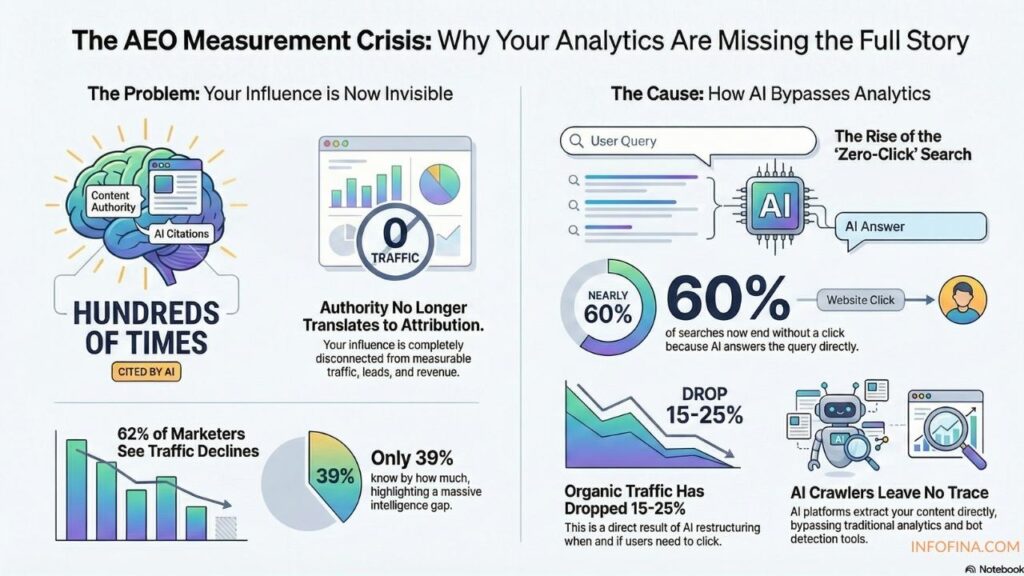
Nearly 60% of searches now end without a click. Not because your content failed. AI answered the question using your content. No one visited your site.
Bain research shows 80% of consumers rely on zero click results 40% of the time. Organic web traffic dropped 15 to 25% as a direct result.
This is not gradual erosion. This is category disaggregation where search results became destinations.
People.com sees 71.2% zero click rates on queries triggering AI Overviews. Mail Online jumped from 48% to over 60% in months.
The pattern matters more than the event. AI Overviews didn’t reduce clicks. They restructured when clicks happen at all.
You optimized for rankings. AI removed you from the funnel.
Bottom line: AI platforms extract value from your content without sending measurable traffic.
How AI Platforms Bypass Your Analytics
Traditional analytics tools register nothing when AI systems access your content. ChatGPT Search, Perplexity, Claude pull your pages and extract your insights. They cite your brand and leave zero trace in Google Analytics.
You have no visibility into which pages AI crawls. How often they visit. What gets cited. What gets ignored.
62% of marketers have seen traffic declines from search engines. Only 39% know the percentage.
This is the intelligence gap. Companies know something is changing but don’t measure what matters.
Worse. ChatGPT Atlas browser clicks paid advertisements and mimics human behavior, consuming ad budget without real prospect intent.
Many AI platforms strip referrer data, causing visits to appear as “Direct” traffic. GA4’s automated bot filtering excludes AI driven link previews. Traditional bot detection tools don’t work. Atlas driven interactions originate from standard browser environments.
You’re flying blind in the channel growing fastest.
Bottom line: Traditional analytics weren’t built to detect or measure AI driven traffic.
What Causes Citation Volatility in AI Responses?
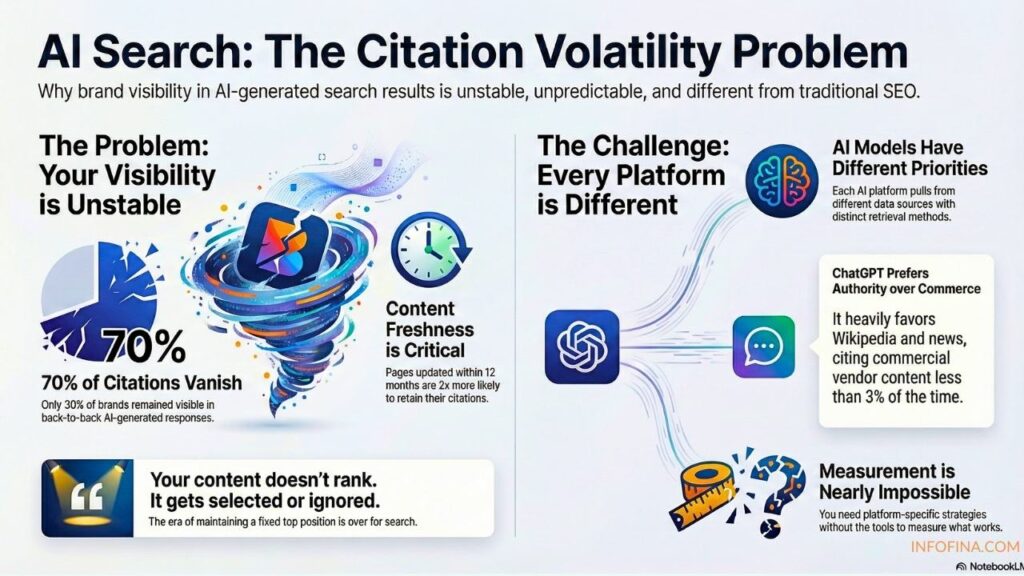
Only 30% of brands remained visible in back to back AI responses.
1 in 5 brands maintained visibility from first run to fifth run across 45,000+ citations analyzed.
The era of maintaining a fixed number one position is over. Each query generates output from a fresh sample of sources. Your content doesn’t rank. It gets selected or ignored based on factors you don’t control.
Brands earning both citation and mention were 40% more likely to resurface.
You have no way to know which category you fall into. Manual checking across platforms is your only option.
Pages updated within 12 months are 2x more likely to retain citations. 60% of commercial queries cite content refreshed within six months.
Content decay now happens on AI timescales, not annual SEO cycles. You don’t know decay velocity. You don’t know citation frequency.
Bottom line: Your content gets selected or ignored based on factors you don’t control. Citation visibility decays faster than traditional SEO.
How Do Different AI Platforms Choose What to Cite?
Your brand might appear in ChatGPT yet be invisible in Perplexity. Each AI platform pulls from different data sources. Each uses distinct retrieval methods.
ChatGPT heavily favors Wikipedia (27% of citations), established news (27%), and blogs (21%). It rarely cites vendor content, less than 3%.
Perplexity, AI Overviews, and Gemini cite vendor blogs around 7% of the time. ChatGPT does so only 1%.
Organizations implementing comprehensive AEO strategies report capturing 23% more total search visibility. Those focusing exclusively on traditional search engines miss this opportunity.
“Comprehensive” requires tracking visibility across platforms you don’t access. It requires measuring citations you don’t see. It requires optimizing for algorithms you don’t reverse engineer.
You need different content strategies for different AI platforms. You have no data to build those strategies.
Bottom line: Each AI platform uses different retrieval methods and data sources. You need platform specific strategies. You don’t have measurement tools to inform them.
Why You Can’t Prove AEO ROI
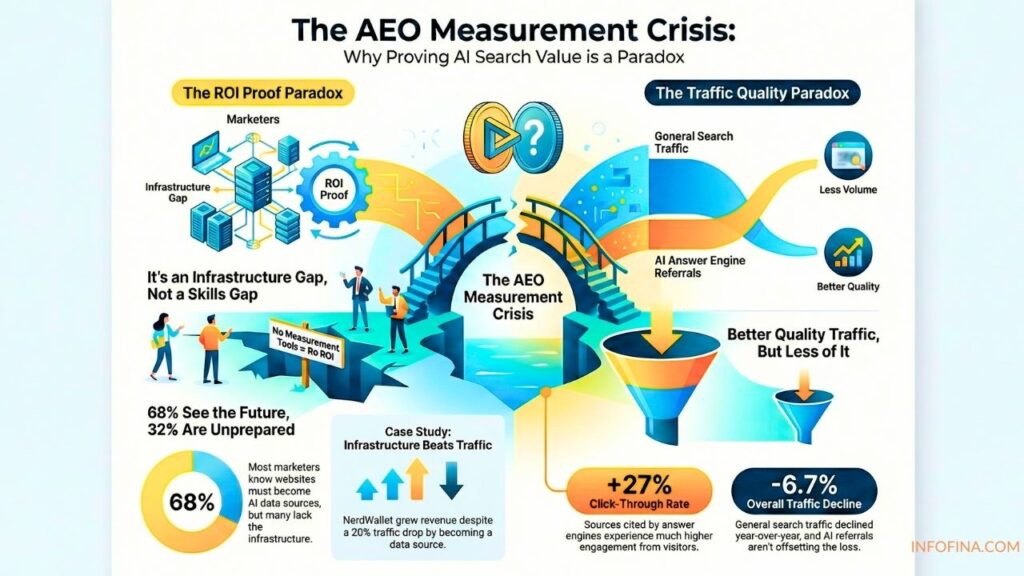
68% of marketers believe their websites will evolve to serve as AI data sources. 32% are structurally unprepared for the shift already happening.
Marketers’ biggest blockers are budget, expertise, and clarity on ROI.
You don’t prove ROI without measurement. You don’t get budget without proving ROI. You don’t build expertise without budget.
This isn’t a skills gap. This is an infrastructure gap.
The tools don’t exist yet. The standards aren’t established. The platforms aren’t transparent.
NerdWallet reported 35% revenue growth despite 20% decline in site traffic. They ensured brand expertise reached consumers through snippets and alternative channels. Stack Overflow experienced 18% traffic drop after ChatGPT launched.
The difference shows infrastructure beats traffic optimization. Companies treating their sites as AI data sources survive. Those optimizing for clicks face extinction.
How do you measure “data source effectiveness” when you don’t see the data being sourced?
Bottom line: The ROI proof gap is an infrastructure problem. Measurement tools, standards, and platform transparency don’t exist yet.
What Is the Traffic Quality Paradox in AEO?
Sources cited by answer engines experience 27% higher click through rates.
This sounds like good news until you check the data. General search referral traffic to 1,000 web domains dipped from 12 billion visits in June 2024 to 11.2 billion in June 2025. That’s a 6.7% year over year decline.
AI referral traffic growth isn’t offsetting search decline. The total pie is shrinking. Citation quality improves while volume drops.
You get better traffic from fewer sources.
You don’t measure which sources drive traffic. You don’t optimize for what you don’t measure. You don’t prove value without metrics.
The measurement crisis isn’t about missing data. It’s about the fundamental decoupling of visibility from attribution. Authority no longer connects to traffic. Influence no longer connects to revenue.
Bottom line: Citation quality improves while total traffic volume declines. Better performance metrics mask overall channel shrinkage.
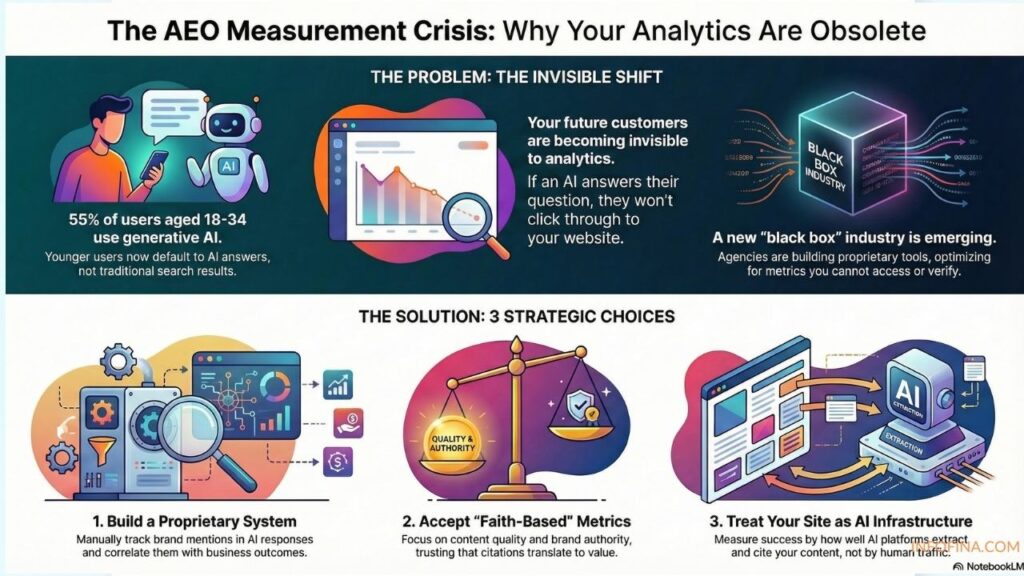
How Demographics Are Shifting to AI First Search
The 18 to 24 age segment shows 55% generative AI penetration. The 25 to 34 segment matches at 55.2%.
Generative AI share of total users more than tripled between 2023 and 2025, rising from 16.9% to 46%.
The demographic shift is accelerating. Younger cohorts default to AI answers, not search results. They won’t click through if AI answered their question. They won’t appear in your analytics if they found you through Perplexity.
Your future customers are already invisible to your current measurement systems.
Bottom line: Younger users default to AI answers over traditional search. Your future customers are already invisible to current measurement systems.
What Are Your Options for Measuring AEO?
The Agency Infrastructure Gap
First Page Sage was the first agency to offer AEO services in 2023. They publish proprietary studies quarterly.
By late 2025, 78 companies were evaluated in the AEO agency space. Top performers measured on AI Platform Visibility Score (25% weight). Client Portfolio Quality (20%) and Technical Implementation Expertise (18%) also factored in.
An entire industry infrastructure is forming around a channel most companies don’t yet track.
Agencies are building proprietary measurement tools because standard tools don’t work. They’re charging for visibility you don’t verify. They’re optimizing for metrics you don’t access.
This isn’t a temporary gap. This is the new normal.
Measurement happens outside your systems. Optimization happens in black boxes. Results happen without attribution.
Bottom line: Agencies are building proprietary AEO measurement tools because standard analytics don’t work. A new industry is forming around a channel most companies don’t yet track.
Three Strategic Approaches to AEO Measurement
You don’t fix the measurement crisis with better analytics.
The platforms won’t give you the data. The tools don’t capture what the platforms hide. The standards don’t exist yet.
You have three options.
One. Build proprietary measurement systems that manually track citations across platforms. Monitor brand mentions in AI responses. Correlate indirect signals with business outcomes.
This requires significant investment in tools that become obsolete when platforms change.
Two. Accept that AEO operates on faith based metrics.
Optimize for what you control: content quality, structured data, brand authority. Trust that citations translate to business value. Accept you won’t measure the connection.
Three. Treat your website as infrastructure for AI systems. Stop treating it as a destination for human visitors.
Measure success by how well AI platforms extract and cite your content. Not by how many people click through.
The companies winning in AEO aren’t the ones with the best dashboards.
They recognized earliest that visibility and traffic have permanently decoupled. Authority and attribution no longer map cleanly. Influence happens in spaces you don’t see.
The measurement crisis isn’t a problem to solve. It’s a reality to navigate.
The question isn’t how to measure AEO. The question is how to operate when measurement itself becomes unreliable.
Your competitors are already making that shift. The ones who wait for better tools will optimize for a dead channel.
Bottom line: You don’t fix the measurement crisis with better analytics. You navigate it by choosing how to operate when measurement becomes unreliable.
Frequently Asked Questions About AEO Measurement
How do I know if AI platforms are citing my content?
You don’t, not with standard analytics tools. Traditional platforms like Google Analytics and GA4 don’t register AI system access. You need manual checking across platforms. Or you need proprietary measurement tools that track AI citations. First Page Sage and similar AEO agencies offer monitoring services. These tools are expensive. They will become obsolete as platforms change their systems.
Why don’t zero click searches show up in my analytics?
Because AI platforms answer questions using your content without sending users to your website. When ChatGPT or Perplexity cites your research, they display information directly. No click means no referrer data, no session tracking, no visibility. This is the zero click problem affecting 60% of searches.
What’s the difference between citation and mention in AI responses?
Citation means the AI platform directly references your specific content or data. Mention means your brand name appears without direct attribution to your content. Brands earning both citation and mention are 40% more likely to resurface. You have no way to track which category you fall into. Manual verification across platforms is your only option.
How often should I update content for AEO?
Pages updated within 12 months are 2x more likely to retain citations. 60% of commercial queries cite content refreshed within six months. Content decay happens on AI timescales, not annual SEO cycles. This means you need more frequent updates than traditional SEO required. You don’t know decay velocity. You don’t measure citation frequency.
Do different AI platforms require different optimization strategies?
Yes. ChatGPT heavily favors Wikipedia (27% of citations), established news (27%), and blogs (21%). It rarely cites vendor content, less than 3%. In contrast, Perplexity, AI Overviews, and Gemini cite vendor blogs around 7%. Each platform pulls from different data sources. Each uses distinct retrieval methods. You need platform specific strategies. The problem is you have no data to build those strategies.
Can I prove AEO ROI to stakeholders without measurement data?
This is the ROI proof gap. You don’t prove ROI without measurement. You don’t get budget without proving ROI. You don’t build expertise without budget. Your three options are: build proprietary measurement systems (expensive and quickly obsolete). Or operate on faith based metrics (optimize content quality and trust citations translate to value). Or treat your website as AI infrastructure (measure by extraction quality, not clicks).
Is the AEO measurement crisis temporary or permanent?
This isn’t a temporary gap. This is the new normal. The platforms won’t give you the data. The tools don’t capture what the platforms hide. The standards don’t exist yet. Visibility and traffic have permanently decoupled. Authority and attribution no longer map cleanly. The measurement crisis isn’t a problem to solve. It’s a reality to navigate.
How are companies succeeding in AEO without measurement tools?
NerdWallet reported 35% revenue growth despite 20% decline in site traffic. They treated their site as infrastructure for AI systems. Stack Overflow experienced 18% traffic drop after ChatGPT launched. They optimized for clicks instead. The companies winning aren’t the ones with the best dashboards. They’re the ones who recognized earliest that infrastructure beats traffic optimization. They optimize content quality, structured data, and brand authority. They don’t track direct attribution.
Key Takeaways
- AI platforms cite your content millions of times invisibly: Traditional analytics tools don’t register when AI platforms access and cite your content. This creates a structural measurement crisis.
- Zero click searches eliminate measurable traffic: Nearly 60% of searches now end without clicks. AI answers questions directly using your content. Organic web traffic dropped 15 to 25%.
- Citation visibility is unstable: Only 30% of brands remain visible across multiple AI responses. Your content gets selected or ignored based on factors you don’t control.
- Each AI platform requires different strategies: ChatGPT favors Wikipedia and news, 27% each. Perplexity cites vendor blogs 7x more often. You need platform specific optimization. You have no data to build those strategies.
- The ROI proof gap blocks investment: You don’t prove ROI without measurement. You don’t get budget without ROI proof. You don’t build expertise without budget. This creates a structural barrier to AEO adoption.
- Younger demographics are already AI first: 18 to 34 year olds show 55% generative AI penetration. Your future customers default to AI answers. They’re invisible to current measurement systems.
- Success requires treating your site as AI infrastructure: Companies like NerdWallet grew revenue 35% despite traffic dropping 20%. They optimized for AI extraction, not clicks. Infrastructure beats traffic optimization.
AEO Measurement Statistics and Platform Comparisons
| Metric or Entity | Value or Percentage | Description |
Platform / Source Type
|
| Zero Click Search Rate | 60% | Percentage of searches that end without a click because AI answers questions directly. |
General Search / AI Overviews
|
| Organic Web Traffic Decline | 15% to 25% | Direct drop in organic website traffic resulting from AI-driven zero-click results. | Web Analytics |
| Brand Visibility Consistency | 30% | Percentage of brands that maintain visibility across back-to-back AI responses. |
AI Response Platforms
|
| Wikipedia Citation Rate | 27% | Frequency at which the platform cites Wikipedia as a primary information source. | ChatGPT |
| Vendor Blog Citation Rate | 7% | Frequency of citing vendor blogs compared to only 1% for ChatGPT. |
Perplexity / Gemini
|
| Generative AI Penetration (18-34) | 55% to 55.2% | Demographic adoption rate for AI-first search behavior among younger users. |
Demographic Data
|